The daily planning app category is relatively new, really only emerging in the past 5 years as an evolution to the tools coming out of the 2010's such as Todoist, Wunderlist (later acquired by Microsoft) and more advanced project management tools like Asana, Monday, and ClickUp.
/
Select
FTC compliant

5 Best Daily Planner Apps in 2026
Updated Apr 26, 2026
See how our top 3 picks compare across the 5 daily planner apps we evaluated.
Explore what each does best, where it falls short, and why it earned a spot on our 2026 list.


 MotionBest4
Best for AI auto-scheduling and workload management
Best for AI auto-scheduling and workload management SunsamaBest3
Best for mindful individuals
Best for mindful individuals AkiflowRecommended2
Best for task consolidation from third party apps
Best for task consolidation from third party apps Morgen Calendar0
For simple calendar‑centric daily planning
For simple calendar‑centric daily planning Routine0
Free daily planner
Free daily planner
Best Daily Planner Apps at a Glance
5 apps and 5 deals

Watch the Full Breakdown
What You Need to Know About Daily Planner Apps
From To-Do Lists to Daily Planner Apps
From To-Do Lists to Daily Planner AppsWhat Makes a Daily Planner App Different
What Makes a Daily Planner App DifferentWhile these tools allow you to put all your tasks in one place, when it comes to getting things done, there wasn't really anything that allowed you to actually plot your tasks on your calendar prior to the daily planner software category.
What Daily Planner Apps Help You Do
What Daily Planner Apps Help You DoDaily planning apps provide a centralized platform to organize tasks, appointments, priorities. Create to-do lists, set deadlines, plot them on your calendar to help you visualize what needs to get done when. If you're anything like us you might have been already doing this on your calendar (for example in college or university), but it was a manual chore 👀
Why Daily Planner Apps Reduce Mental Overhead
Why Daily Planner Apps Reduce Mental OverheadDaily planner apps help increase productivity, as you can plan out everything you need to get done a week or more in advance. They also reduce the cognitive overload that comes from wondering "what needs to get done next".
Best Daily Planner Apps Ranked & Reviewed
Watch our full breakdown of the top daily planner apps, how they performed in testing, and what makes each one worth considering
Recorded by our expert reviewers
Alex
and Andra
Independent, hands-on testing.Learn more
How We Evaluate Daily Planner Apps
We score each daily planner app across AI auto-scheduling, adaptive rescheduling, cognitive clarity, planning methodology, integrations, and hands-on expert evaluation
- AI Auto-SchedulingAutomatically builds your day by time-blocking tasks based on priority and availability.
- Adaptive ReschedulingAdjusts your schedule in real time when plans change, shifting tasks automatically.
- Cognitive ClarityReduces mental clutter by simplifying priorities, plans, and next actions.
- Planning MethodologyThe app intuitive, easy to navigate, and quick to learn.
- IntegrationsConnects with your existing tools to centralize tasks, calendars, and communication.
- Expert EvaluationCurated by, our rankings reflect in-depth testing, industry insights, and hands-on experience.AlexandAndra
1
Motion
Best
4
Best for AI auto-scheduling and workload management
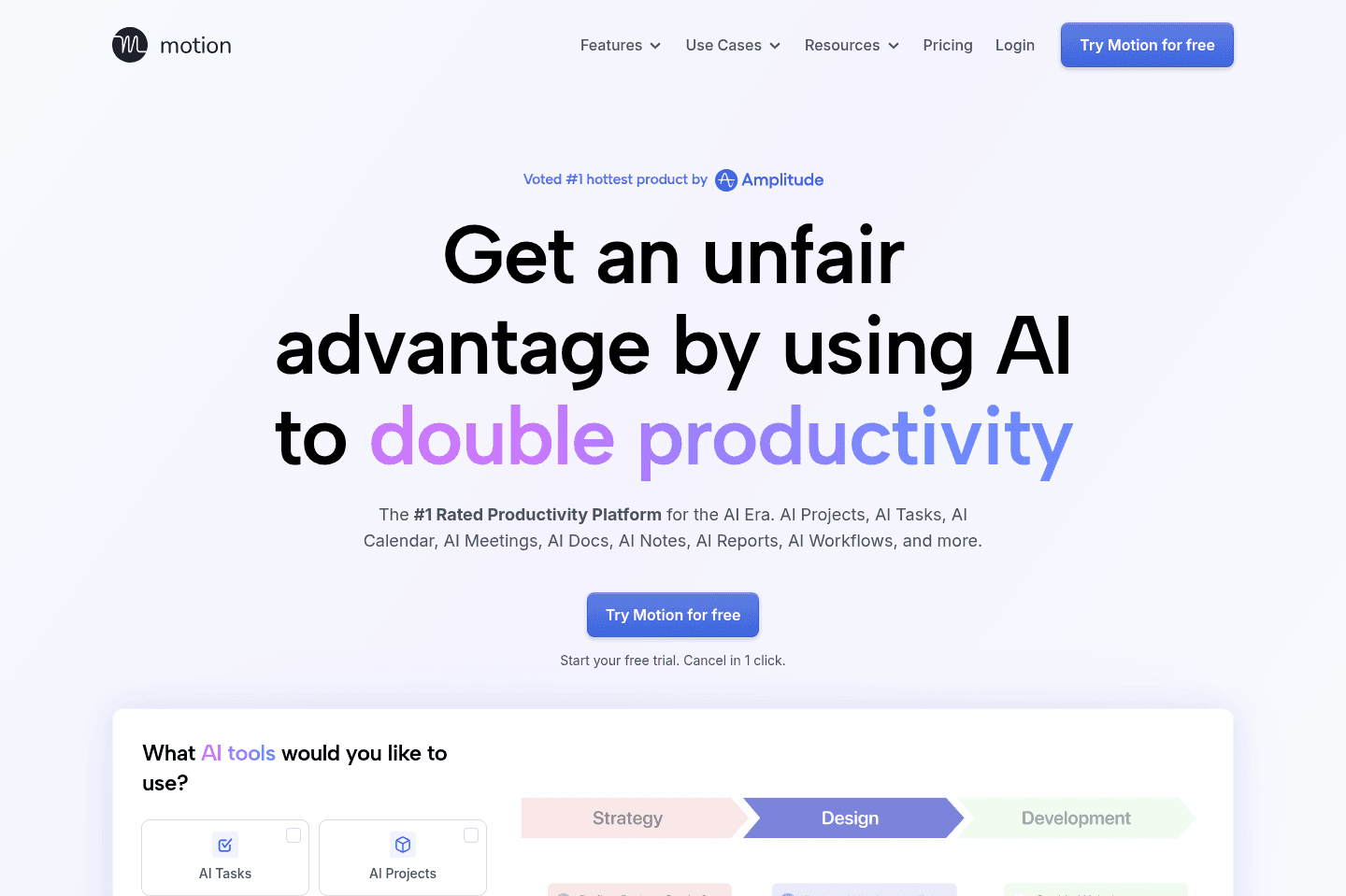
Best for AI auto-scheduling and workload managementMotion is the most innovative AI-powered project management tool for individuals and teams who want to fully embrace AI to get work done.
It uses AI to take all of your team's projects, tasks, priorities, deadlines, and dependencies to build the perfect day for you and your team, time blocking tasks right on your calendar. They also have AI Docs, & an AI Note Taker, helping you get work done faster.
We've been using it for 5 years and is core to how we manage our time and projects!
Go to Motion site
What is Motion?
What is Motion?Motion is a calendar-first, AI-powered project management system that brings your tasks, meetings, documentation, and team workload into one tool.
Previous to using Motion, we used Asana for seven years. It kept us organized enough, but I was spending at least an hour or two every week just "cleaning up" the tool so it wouldn't fall apart. Deadlines would shift, priorities would change, and suddenly half the board was out of date. That's why we switched to Motion five years ago and haven't looked back.
The core thing Motion does differently is it actually schedules your tasks onto your calendar automatically, based on deadlines, priorities, and availability.
And when plans change, which they always do, it updates everything for you. What really got me early on was the deadline visibility. If our team has 5 hours of meetings in a day and 8 hours of work scheduled, Motion flags that we're at risk before it becomes a problem.
We use it to manage our entire YouTube production process, from scripting and filming to editing, reviewing, and distributing.
Recently, Motion has become more of an all-in-one tool. On top of being a calendar and project management tool, you can also store all of your notes and documentation in the app via their AI Docs and meeting recorder. This is especially helpful as you can tie meeting notes to projects, and when asking the Motion AI Assistant it has full context on projects, discussions, and notes.
And they didn't just tack on these features either... their meeting recorder is one of the best we've used (for instance, it creates tasks automatically at the end of each call, allowing you to assign it to team members directly).
So if you want a project management tool that will help your team just focus on getting work done (instead of babysitting your project management tool), give it a shot.
Pros and Cons
Pros and ConsPros
Pros- Only calendar-first project management tool on the market
- Automatically schedules tasks directly on your calendar using AI
- Takes your entire schedule (meetings + work) into account
- Has most traditional project management features (gantt charts, kanban views)
Cons
Cons- Not ideal if you don’t want AI automatically managing your schedule
- The interface can feel cluttered
- Minimal reporting & dashboards
- Not for enterprises
Key Features
Key FeaturesProject Management
Project ManagementMotion has all your traditional project management capabilities including kanban, gantt charts, and list views. But on top of that, they also have a calendar at the core that schedules tasks from your projects onto your calendar. No other tool fully integrates at this level.
Calendar
CalendarMotion is the only project management tool on the market built with a calendar at the core. We use it as a full replacement for Google Calendar in our day to day (on top of using it for project management). Motion is truly one of the best calendar apps on the market if you're looking for something powerful.
AI Auto-Scheduling
AI Auto-SchedulingManaging your workload is tiring, we experienced it ourselves every time we had to rearrange our tasks and priorities when using Asana. That's why daily planner apps came on the market, allowing you to pull in tasks from other project management tools and plan them on your calendar.
But Motion chose not to integrate with daily planner apps, and instead become one of the best daily planning apps themselves and built powerful project management features on top (while also using AI to automatically create your schedule for you like an assistant would). So what does this mean?
Didn't get something done? No worries, Motion will reschedule it for you based on the priority on your calendar. At risk of missing a deadline? Motion will warn you and you can fix it with a few clicks. Want to push back the deadline of a bunch of projects? Tell their AI Chat and it'll do it for you.
You can even forward emails into Motion and it will automatically create a task and schedule it on your calendar.
Workflow Templates
Workflow TemplatesWorkflow Templates in Motion are reusable project templates that define exactly how your work gets done from start to finish. They include your roles, stages, tasks, and key details so every project follows the same structured process.
Once set up, Motion uses the template to automatically schedule everything on your team's calendars and adjust timelines when things change. This makes starting projects incredibly easy & fast!
AI Docs
AI DocsMotion’s AI Docs are great for keeping processes and notes right inside your projects, perfect if you don’t already have a knowledge base software in place. That said, don't expect it to be as powerful as Notion or Slite. Motion AI docs are more suitable for basic documentation and notes.
The best part of using Motion Docs for all your notes is that you can quickly tag projects and tasks within the docs itself. And when searching across your projects with Motion's AI Assistant, you get a full picture of project updates (it takes into account your projects, docs, and even meeting notes so when you ask for an update, it can truly give you an accurate picture of what happened).
But as a heads up, when we really want to do serious writing (e.g. scripting or a full software review), we find ourselves opening Motion within Dia or ChatGPT Atlas (our browsers) because using their sidebar chat assistant is faster for writing in our tone, brainstorming, and doing research.
Meeting Recorder
Meeting RecorderWe love Motion's Meeting Recorder, and if you're already using Motion for your projects, there's really no reason to use another one. It automatically joins your meetings (you just have to let it in), records video and text, and then uses AI to organize the notes for you. It also automatically creates tasks from the meeting notes and all you need to do is approve or deny them.
Pricing
Pricing- Pro AI: $19/seat/mo (billed annually). Best for professionals and small teams who want AI-powered project management, scheduling, and task planning.
- Business AI: $29/seat/mo (billed annually). Best for teams that need advanced reporting, capacity planning, time tracking, permissions, and centralized billing.
- AI Credits: Included with each plan. Pro AI includes 7,500 credits/seat/month and Business AI includes 15,000 credits/seat/month.
Subscribe for updates
Get the latest rankings and insights on top Daily Planner apps—delivered to your inbox. Stay ahead with our expert picks and updates.
2
Sunsama
Best
3
Best for mindful individuals
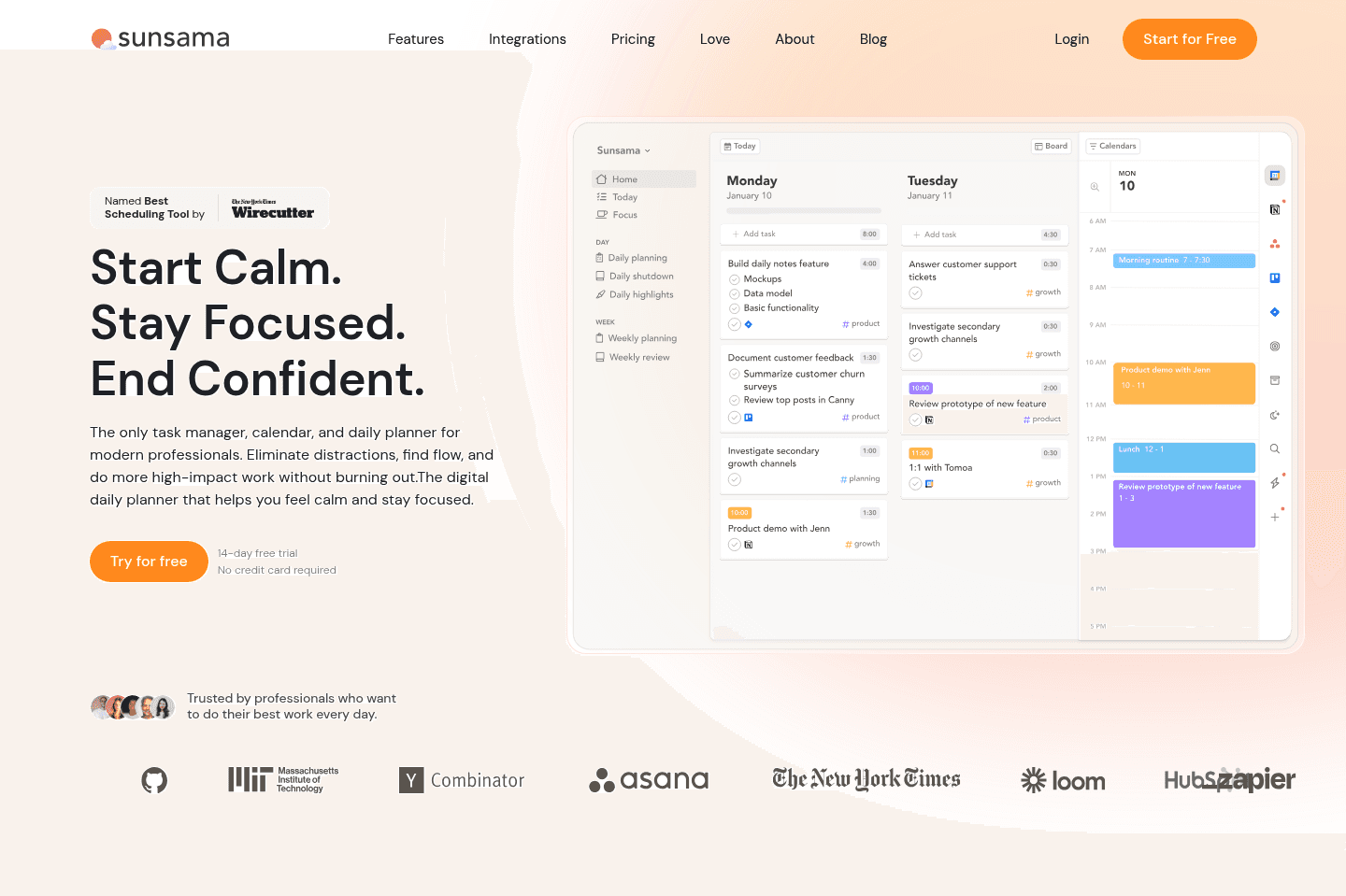
Best for mindful individualsSunsama is a beautifully designed daily planning app.
It's great for those who enjoy the ritual of planning their day, and don't want to lose the intentionality aspect of daily planning. If you love pen & paper daily planning, yet want a digital planner, but hate the idea of AI running things for you, Sunsama is for you.
Make sure to grab a Sunsama free trial for a free 30 days, if you want to try it (this is normally only 14 days if you go through their site). No credit card required so giving it a shot is easy compared to other daily planners.
Go to Sunsama site
What is Sunsama?
What is Sunsama?Sunsama is a daily planner built around intentional, manual time blocking. The very first thing it asks each morning is "What do you want to get done today?"
It's intuitive and easy to navigate, giving you a full view of your tasks on one side and your calendar on the other. You have the ability to drag tasks onto your schedule and then reflect on obstacles. Then, at the end of the day, you go through a shutdown ritual and review what you completed. It’s not a tool that's trying to automate your life, but trying to help you be more mindful about it.
I always recommend Sunsama to my friends who love pen-and-paper planners but want a digital version. If you enjoy sitting down for 10–15 minutes each morning to thoughtfully plan your day, you'll probably love what Sunsama brings to the table.
If you hate the idea of AI planning your day, then Sunsama is 100% for you (it's basically the opposite of Motion). There's no AI auto-scheduling or project management tool built in.
Pros and Cons
Pros and ConsPros
Pros- Structured daily routines
- Beautiful, calming, minimal design
- Daily planning and time blocking experience
- Strong philosophy around healthy work habits
- Integrates with popular tools (Asana, Monday, Gmail, Slack, etc.)
Cons
Cons- Heavy manual daily planning
- Limited team collaboration features
- Can feel time-consuming for busy professionals
Key Features
Key FeaturesDaily Planning
Daily PlanningSunsama creates an experience that guides you through a routine focused on what you feel, not what is fastest or what an AI automation thinks is most efficient.
There is what Sunsama calls auto-scheduling, which is different from how AI works with tools like Motion. What it means is it uses a mixture of keyboard shortcuts and your preset schedule to place tasks on your calendar, split them, or defer them; it's not actually doing anything with AI or anything that automated.
We could see this really working for someone who prefers control over AI guesswork and already likes sitting down to map out their day. This feels like the cleanest digital version of that experience. It forces you to be realistic about your time and in tune with your day.
Task Aggregation
Task AggregationSunsama doesn’t try to replace your project management software, but it's aware that professionals often need to be in tools like Asana, Monday, Trello, Gmail, Slack, etc.
So it connects to those tools and allows you to pull in tasks, BUT it doesn’t automatically schedule everything. This is different from other tools that, with a click of a button, your entire schedule is ready to go; with Sunsama, you choose what makes it onto your calendar.
It acts more like a daily decision layer on top of your existing stack. Your PM tool manages the big picture, and Sunsama helps you decide what actually gets your time today.
Daily Shutdown & Reflection
Daily Shutdown & ReflectionMuch like the beginning of your day, Sunsama has you do a shutdown routine at the end of the day. You review what you completed and reflect on how the day went.
This might sound redundant if you are just trying to be as efficient as possible, but if the goal is awareness and intention, it's powerful. A lot of busy founders just want to close their laptops and be done with the day, but Sunsama makes you pause and look at your progress.
It does a great job of helping you reinforce work boundaries and help you build a healthier relationship with work, because when you see all your output, it makes you realize sometimes it's okay to stop.
Pricing
Pricing- Free: 30-day free trial with our Sunsama discount (normally only 14 days if you go direct). No credit card required.
- Pro: $20/mo per user (billed yearly) or $25/mo (billed monthly). Best for busy professionals who want a full daily planning system with unlimited usage, integrations, and AI features.
- Enterprise: Unlisted. Includes SSO, SCIM, audit logs, and custom security, compliance, and billing options for larger teams.

Superhuman Mail
Featured
Get through your inbox 2x as fast (for teams of all sizes).
3
Akiflow
Recommended
2
Best for task consolidation from third party apps
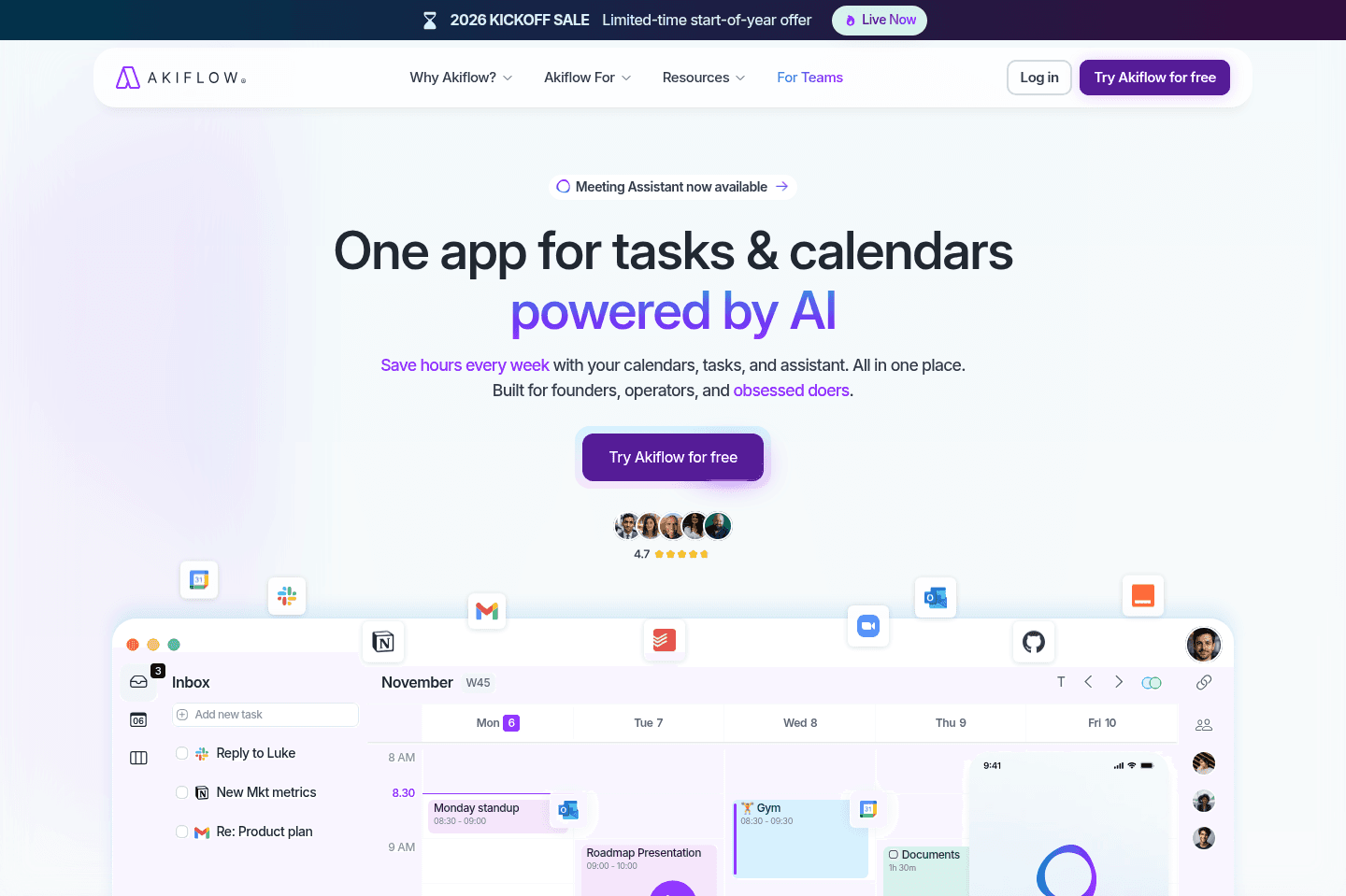
Best for task consolidation from third party appsAkiflow is a daily planner for task consolidation (aka bringing tasks from many different apps into one place so you can more easily triage). It has integrations with tons of tools like ClickUp, Asana, Monday, and communication tools like Slack and even your email.
When we used it, we didn't stick to it (turns out adding all of our tasks in one place resulted in overwhelm after a few weeks).
Go to Akiflow site
What is Akiflow?
What is Akiflow?Akiflow is a tool that has copied a bit from its competitors. It has a "daily shutdown" feature borrowed from Sunsama and an identical pricing structure to Motion. With that said, the pieces they've brought together are great for individuals who are drowning in tasks across too many apps (with a caveat, explained below).
If you're a busy professional whose company has tied you down to tools like Slack, Trello, Google Calendar, or Monday or other project management tools, and you want one place to centralize all your tasks in one big todo list, that's what Akiflow was created for.
Now the caveat: If you decide to dump everything into Akiflow, your inbox can become overwhelming fast. Unlike Motion, it won’t automatically prioritize and rearrange your day, so you'll still need to manually plan.
We used Akiflow when it first came out a few years ago, after about a month we found we over did it. Turns out that adding every Slack message, email, and task to one interface ends up being overwhelming, and hard to keep up with 😅 So we stopped using it.
Knowing that, don't make the same mistake we did and add everything to Akiflow. Keep just your most important stuff in there.
The task manager it's works well though. It lets you drag new or imported tasks to your calendar, then lets you decide what you want to do with them (snooze, plan, or reschedule). The UI is clean, and the keyboard shortcuts are reminiscent of Superhuman Mail, which makes for quick work once you get the hang of it.
So, overall, it comes down to what you're looking to solve. If that's centralizing tasks across your many apps, then Akiflow is going to do just that, but if your problem is more prioritization and workload management, there are other, stronger tools out there.
Pros and Cons
Pros and ConsPros
Pros- Fast keyboard shortcuts
- Clean, focused interface
- Consolidates tasks into one inbox
- Strong integrations (including Zapier)
- Built-in scheduling links for sharing availability
Cons
Cons- Easy to overload your inbox
- Can feel repetitive if you fall behind on triage
- Basic AI features (Not as robust as advertised)
Key Features
Key FeaturesCentralized Task Inbox
Centralized Task InboxAkiflow can help reduce chaos when you have tasks that live in different places. For example, when you start something in Gmail, pop over to Slack to comment, or jump into Asana to assign yourself a new task, all of that gets added to your cognitive load, and somewhere in between, half of it gets forgotten. Since Akiflow can integrate with many common tools, its centralized inbox gives you a single source of truth for "what's next."
For more technical individuals or teams, Akiflow also offers API access and Zapier integrations. Meaning you can build automations. So, if you had your CRM platform and wanted to automatically create a task when a new lead is added to your CRM or when a support ticket hits a certain status.
Task Triage
Task TriageAkiflow lets you triage tasks (plan, snooze, or reschedule), and they've included keyboard shortcuts that help speed things up. The system is highly manual, so when you inevitably fall behind or miss a day, catching up requires some legwork on your part.
And, while they do have "Aki," their "AI Assistant like in the movies" who is supposed to be your "Executive Assistant beyond human limits," we were pretty disappointed when we tested it out.
Don't expect this AI to do much heavy lifting because it acts more as a ChatGPT wrapper than a complex assistant.
Manual Time Blocking
Manual Time BlockingYou can drag tasks directly onto your calendar right from your inbox and plan your day.
It's more of a hands-on feature that requires intentional planning, but means more control too. You get to decide when things happen and how long they take. Basically, nothing moves unless you move it.
For some, that's great, especially if you really need a place to aggregate your tasks so you can visualize them and start executing. Just know that anytime priorities shift, you will need to hop back in and rework your calendar, versus tools like Motion that utilize AI to do it for you.
App Pricing
App Pricing- Monthly Plan: $34/month (Quite expensive compared to other daily planners that are more powerful)
- Yearly Plan: $19/month billed annually
4
Morgen Calendar
0
For simple calendar‑centric daily planning
For simple calendar‑centric daily planningWith Morgen Calendar, you will get a better experience than Google Calendar/Outlook.
It feels faster and has a better design, and you also have the ability to add barebones tasks to Morgen. So if you're just starting to dip your toes into the daily planning calendar space, Morgen is worth giving a shot.
That said, if you're more serious about daily planning, we think there are better options available.

Go to Morgen Calendar site
What is Morgen Calendar?
What is Morgen Calendar?Morgen Calendar falls into two categories. First and foremost, it's a calendar with a much more beautiful interface than Google Calendar, Outlook, or Apple Mail. The second category Morgen toes the line with is being a daily planning tool. But when considering it as a daily planner tool, it's quite barebones compared to other daily planners on the market.
Morgen's AI planner that help you create plans by recommending when you should work on which tasks. It checks your availability and task deadlines to structure your day, pulling in tasks from other tools to suggest time blocks inside your "Frames" (Morgen’s templated work blocks), then lets you do a once-over before approving.
A while ago, Morgen had a free tier, at at that point we thought it was a good tool to try if you're dipping your toes into the world of daily planning. But with their new pricing, it's tough to justify the cost compared to other tools (for example, Motion is the same price but gives you full project management capabilities plus their AI scheduling is a lot more advanced).
In general, we'd love to see Morgen become more differentiated with time.
Pros and Cons
Pros and ConsPros
Pros- Clean interface
- Integrates with common project management tools
- Drag-and-drop task scheduling directly onto your calendar
Cons
Cons- Less powerful than most daily planners
- Expensive for what they offer
Key Features
Key FeaturesAI Planner
AI PlannerMorgen's AI Planner creates a proposed schedule for your next 1–8 days based on information you created (task priority, availability, and due dates). They also have preview mode within the planner, which is where you'll see proposed tasks "pulse," letting you clearly see what's new. You can tweak, resize, remove, or reprioritize tasks before you decide to add to your schedule.
While it sounds good in theory, this does require you to sit down and "get organized" rather than just building out your day for you. As a busy business owner, I will tell you this is a "sounds nice" feature, but in the day to day, I want to show up and get to work.
But if you want some control over how your tasks are planned, this will appeal to you more than something more automated, like Motion for example.
Frames
FramesFrames are Morgen’s way of helping you get intentional about when you work on certain types of tasks.
Think of them like reusable time templates. For example, you might block off 9–11am for "Deep Work" and 3–4pm for "Admin." Instead of deciding every single day when to focus or when to do lighter tasks, you set those patterns once.
Then that helps Morgen's AI planner to appropriately place tasks inside those frames. So if something is high priority and tagged as deep work, it’ll try to land in your "Deep Work" frame.
While my perfectionist mind truly loves the idea of having perfectly set aside time for similar tasks, unfortunately, this isn't the reality of how I work 90%. As a business owner, I am thrown into unblocking team members, writing a script, then editing a review within a matter of an afternoon.
AI Scheduling
AI SchedulingOnce you have tasks inside the system, the AI has placed them on your calendar, and you have approved, the AI will try to make your schedule more realistic. For example, it will automatically add a little buffer to your task estimates. So, if you're the type to underestimate how long your tasks are going to take, then this is a small but helpful way to counter that.
Not different from other planners, but still a nice-to-have feature, the AI scheduler also splits up your work. Instead of dropping a giant multi-hour block onto your calendar, Morgen helps you fit them more naturally into your day by splitting them across multiple sessions.
Lastly, unlike tools like Motion that automatically shift your schedule around to adjust for overdue or missed items, Morgen will suggest a new time rather than reorganize based on your selection.
It gives you more control over your schedule, but that also means it comes with added mental load of needing another "to do" to approve the tasks.
Pricing
Pricing- Monthly: $30/mo per user. In our opinion, this is far too expensive compared to the other daily planners available.
- Yearly: $15/mo per user (billed annually). This pricing is much more reasonable.
Superhuman Mail
Featured
Get through your inbox 2x as fast (for teams of all sizes).
5
Routine
0
Free daily planner
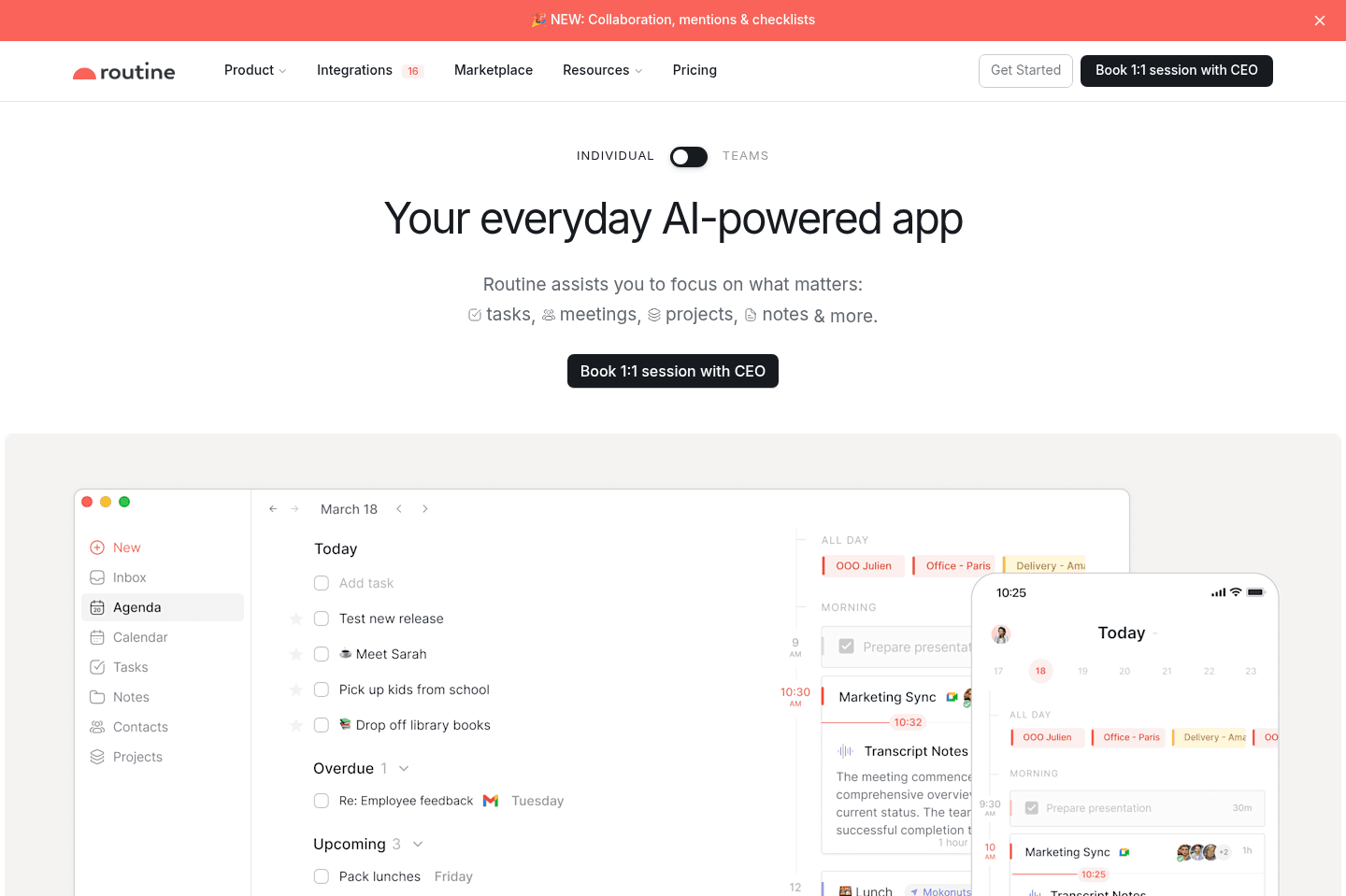
Free daily plannerRoutine tries to be a daily planner productivity suite, but falls short in actual focus. Trying to do knowledge management, project management, and Notion-style databases to connect it all together, leaving it in what feels like a confusing productivity suite.
We wish they just focused more on their daily planning functionality.
Go to Routine site
What is Routine?
What is Routine?The last time we checked out Routine, we went in thinking it was was a lightweight daily planner. Fifteen minutes later, we were scared we'd just deleted their entire task database...😂 Search Routine Review Gone Wrong on YouTube and you'll see what we mean.
Routine is a daily planner with lots of features like task scheduling, label creation, and, of course, a calendar, but with so much happening, a lot of the features don't work fully like you'd want them to. The glaring problem is that their execution makes it hard to understand what it actually wants to be 🫠
Routine is says its for busy professionals and modern teams, but we feel like a student or busy parent is a more appropriate audience based on the limited way many of the features work. Maybe someone who wants a free tool to drag tasks onto a calendar, loosely organize their day, or experiment with time blocking, but gosh, as a business, it will not do what it needs for you. It has a free tier (which is rare in this category), but we can definitely see why, so if you decide to try it, lower your expectations.
Pros and Cons
Pros and ConsPros
Pros- Has a free tier (rare in this category)
- Drag-and-drop task scheduling onto calendar
- Tasks can contain detailed notes
Cons
Cons- Not a ton of integrations
- Not intuitive (basic actions require trial and error)
- Labels system adds complexity without clear payoff
- Feels unstable (easy access to database-level settings)
- Too basic for a primary business calendar
- Identity crisis: calendar vs. daily planner vs. knowledge management tool
Key Features
Key FeaturesTask Scheduling
Task SchedulingRoutine allows you to create tasks and drag them directly onto your calendar. You can adjust time blocks and rearrange your day visually. The time-blocked task planning works, but it feels basic.
They even tried integrating natural language, but even that has its hang-ups. For example, when creating a task, typing "3 days" schedules it for December 3rd instead of three days from now. To get the result you're looking for, you have to type "in 3 days." A small detail that shows good intention, but poor execution.
Labels & Database Structure
Labels & Database StructureRoutine introduces a labels system that acts almost like a relational database. You can assign labels to tasks and events and view counts across categories.
In theory, this would allow for deeper organization, but in practice, it feels like an added mental load. You can see numbers, but you won't extract any valuable insight.
Notes Within Tasks
Notes Within TasksAgain, we have some clarity issues. Routine has tasks that function as full notes, so you have the option to expand well beyond a simple checklist item. This leans into their "all-in-one" ambition, and looks like they were attempting to blend planning with knowledge management.
However, the separation between tasks and notes is confusing, and it's not always clear where things live or how they relate.
Pricing
Pricing- Free: Best for individuals & students looking to become more productive.
- Professional: $10/mo. Best for professionals who want AI notes and time tracking capabilities.
- Business: $15/mo per user. Best for teams who want workspaces and access control.
- Enterprise: Contact for more details. Best for large teams in need of extra security.
6

Reclaim AI
Tries to protect your time
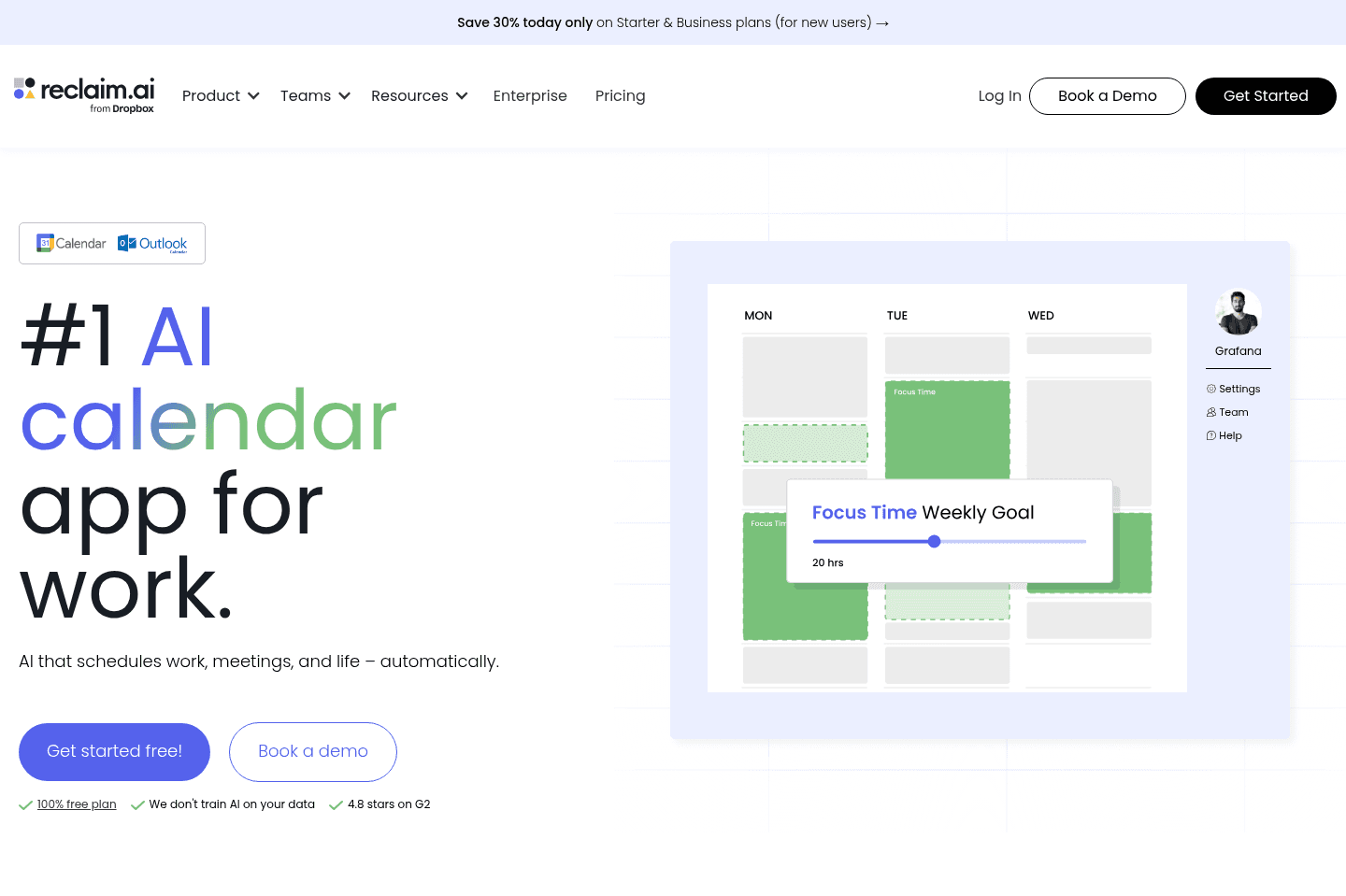
Tries to protect your timeReclaim AI is less of a daily planner, and more of a focused-time calendar time-blocking tool.
While they allow for basic task tracking on the calendar, you'll feel pretty frustrated trying to use it as your main calendar and daily planner.
Go to Reclaim AI site
What is Reclaim.ai?
What is Reclaim.ai?Reclaim's sole purpose is to defend your time from others on your team, in an attempt to give you more time for habits and focus time.
Reclaim works best for individual contributors inside larger organizations. For example, if you're in corporate and your calendar is constantly getting hijacked by meetings, and you want to make sure you have time to eat lunch.
The truth of the matter is Reclaim didn't feel delightful or enjoyable to use, in fact, I felt more like I was using an outdated tool I wanted to get out of.
The daily planner category is in itself a "nice to have" rather than a necessity to get work done, so using something with good user experience is quite key in our eyes.
Pros and Cons
Pros and ConsPros
Pros- Protects focus time with recurring "habits"
- Automatically schedules one-on-ones for managers
Cons
Cons- Slower, outdated UX compared to modern competitors
Key Features
Key FeaturesSmart Habits & Focus Time Blocking
Smart Habits & Focus Time BlockingReclaim is great for creating habits. Smart recurring blocks protect your time for things like:
- Lunch
- Workouts
- Deep work
- Meditation
- Other recurring routines.
You just define a time range, for example, "between 12–2 PM," and Reclaim finds space within that window and dynamically reschedules if conflicts arise.
Task Scheduling & Integrations
Task Scheduling & IntegrationsReclaim integrates with some of the most common companies, like Asana, ClickUp, and Linear. It pulls tasks into your calendar and schedules them. But the truth of the matter, out of all the "auto-scheduling" features we tried with other daily planners, Reclaim's was by far the worst user experience. It just didn't feel enjoyable to use.
Pricing
Pricing- Light: Free plan (limited functionality). Best for individuals experimenting with habit blocking.
- Starter: $10/mo per user. Best for small teams needing more meeting capabilities.
- Business: $15/mo per user. Best for large teams looking for unlimited access.
Superhuman Mail
Featured
Get through your inbox 2x as fast (for teams of all sizes).
7

Notion Calendar
For Notion users only
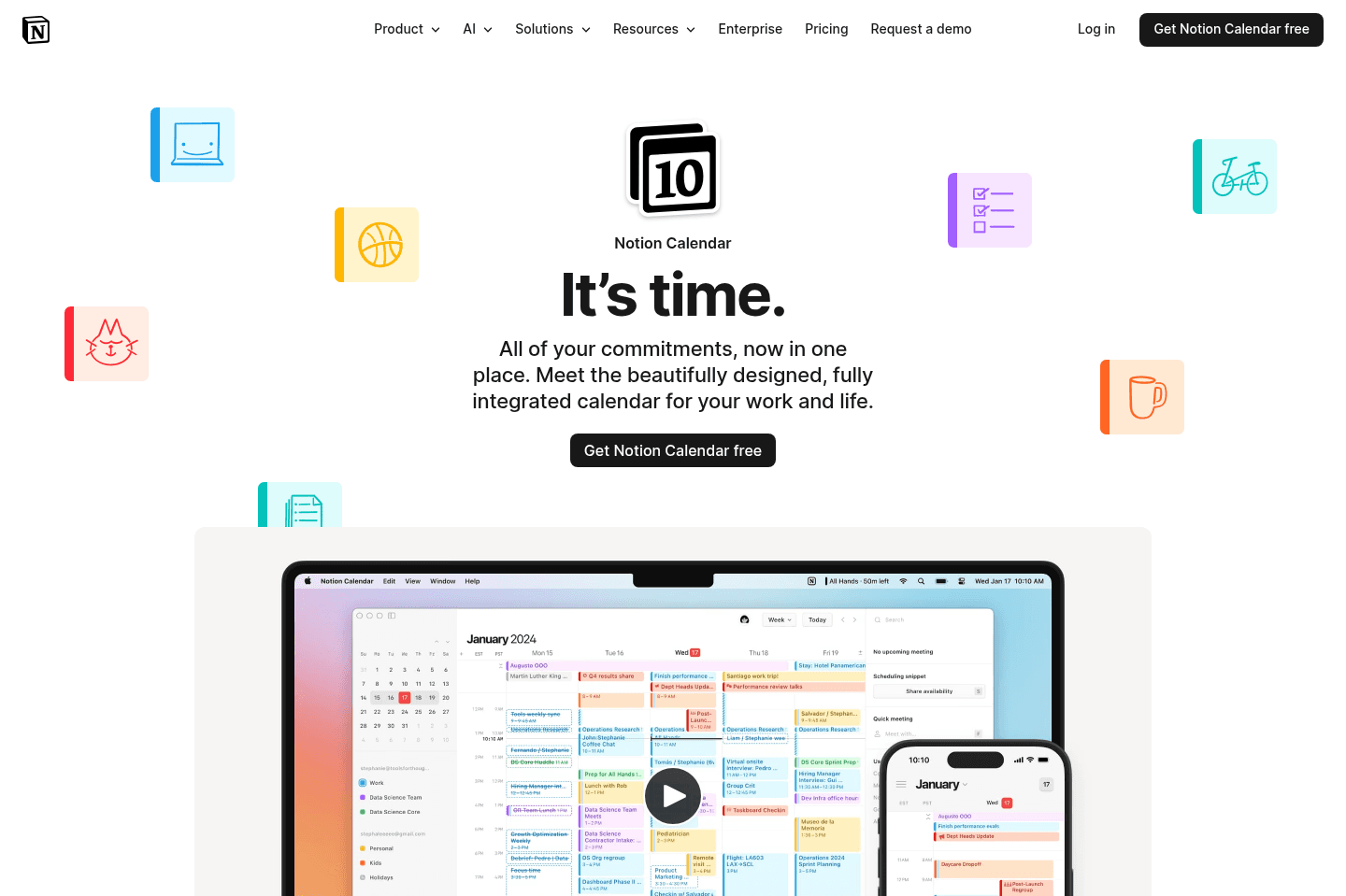
For Notion users onlyNotion Calendar is an aesthetically pleasing calendar for iOS, and we'd recommend using it if all you want is a free calendar that is better than Google Calendar (not available yet for Outlook).
With that, we'd say skip the whole "add your Notion database items to your calendar" bit. Despite the hype, managing your tasks in Notion is messy as it's not a task manager. If you're interested in time blocking tasks, try one of these daily planners instead.
Go to Notion Calendar site
What is Notion Calendar?
What is Notion Calendar?Notion Calendar is part of the greater Notion ecosystem, but we want to be clear: while we highly recommend Notion Calendar as an actual calendar app, we don't recommend it as a daily planner.
Since it integrates into Notion databases, you might be tempted to think, "Hey, I can drag database items (like tasks) onto my calendar to plan my day," but that idea is only good in theory, not in reality.
If you're a deep Notion power user who already manages your life inside databases, this might feel convenient. Everything lives in one ecosystem. You build tasks in Notion, then place them on your calendar. And for you, sure, that can work.
But if you're reading this and you're not using Notion for tasks, don't start (see our Notion review as to why). And certainly do not sign up for Notion Calendar thinking it can be a good daily planner when integrated with Notion just cause it's free. I promise you, this is the path of perceived productivity rather than something actually useful that will move your business forward.
This is one of those tools that feels productive on the surface, but in reality, slows you down. It looks clean, it feels flexible, but you're doing all the work manually. You're not actually getting help planning your day, you're just spending hours organizing it.
Compared to tools like Sunsama or Akiflow, Notion Calendar lacks structured daily planning rituals. It's the complete opposite of Motion; there’s no AI scheduling or workload management. Instead, it's all on you to manage. Bottom line, it's a good calendar, but it's not a daily planning solution.
Pros and Cons
Pros and ConsPros
Pros- Ideal for Notion power users
- Deep integration with Notion databases
Cons
Cons- Not built specifically for daily planning
- Not ideal for scalable business task management
Key Features
Key FeaturesDatabase Integration
Database IntegrationNotion Calendar, originally Cron, was and is an insanely well-designed calendar. But since Notion acquired it, they updated it to include other Notion products (e.g. connecting Notion databases like tasks, projects, and more, directly into your calendar). You can drag Notion pages onto specific time slots on your calendar.
Drag-and-Drop Scheduling
Drag-and-Drop SchedulingNotion did make it fairly simple and straightforward to use. Whatever tasks you do create can be put into time blocks on your calendar.
The problem with that is it's fully manual. There's no AI rescheduling coming to save the day or an adaptive reschedule to dig you out of your missed workload. There are far better tools that can help you reprioritize your tasks.
Unified Calendar View
Unified Calendar ViewNow this is the one redeeming feature. Notion Calendar itself is genuinely good replacement for Google Calendar or Outlook. You can manage all of your calendars, get a good view of your availability, and handle your meetings.
Pricing
Pricing- Free: Best for individual power users very familiar with Notion databases
- Paid: Best for Notion users who want to unlock advanced database features and team functionality (comes as a part of your Notion plan).
Our Final Verdict


Which Daily Planner Wins?
Which Daily Planner Wins?If you want the best daily planner app for most professionals, Motion is the clear winner.
All the tools mentioned help with planning your time, but they're not exactly solving the exact same problem. Motion, Akiflow, and Sunsama are all first-and-foremost daily planner apps for professional use, whereas Routine is more of a lighter personal option.
Why Motion Is the Best Daily Planner for Most Professionals
Why Motion Is the Best Daily Planner for Most ProfessionalsWhat makes Motion different is that it's not just a place to list tasks and drag them onto your calendar manually. It is the only tool here that really feels like an AI assistant, that plans your tasks and projects on your calendar.
It can take tasks from your projects, schedule them onto your calendar, and then adapt automatically when your day changes. If a meeting gets added or something urgent comes up, Motion reshuffles the rest of your day for you. That's the biggest differentiator it has versus the other apps mentioned.
For busy professionals and small teams, that combination of project management with AI scheduling is what makes Motion the most powerful daily planner that works for the whole team, that has the ability to actually upgrade into being a complete project management solution.
Best for Integrations: Akiflow
Best for Integrations: AkiflowAkiflow is the best fit if you are already using tools like Asana, ClickUp, Gmail, Notion, and Slack, and you mainly want one place to consolidate tasks from across your entire software stack.
It's a better fit for people who care a lot about integrations and workflows than those who actually want their day planned for them automatically. That said, we've seen people get bogged down by trying to pipe all of their other tools into Akiflow and then scheduling tasks on the calendar, sometimes taking up more time than just doing the task itself.
If all you're looking for is having other tools integrated in one place, grab the Akiflow discount and give it a shot. If you're actually a founder or running a business, we'd recommend using a app that actually automates the painful scheduling part, and saves you time instead.
Best for Intentional Planning: Sunsama
Best for Intentional Planning: SunsamaSunsama is the best choice for people who actually enjoy planning their day manually and want a calmer, more thoughtful workflow.
It's not trying to automate your schedule in the same way Motion does. So if you're a busy professional, it might actually feel like extra work has been added to your day, but if you are working between many different apps (Linear + Asana + others), then Sunsama does allow you to pull that all into a single view.
The best way to explain it is, if you're excited by the idea of having a daily ritual where you sit down for 10-15 minutes to map out your day intentionally, then Sunsama was built for you. In-fact, they have a full methodology around thoughtful daily planning.
If that sounds like you, you can grab an extended Sunsama free trial and give it a shot.
Best Free Daily Planner App
Best Free Daily Planner AppThere has never been a more accurate sentiment of "you get what you pay for" than what you get with Routine. Yes, they have a free tier, but it's because I don't really think they'd be able to charge you for it. Watch the video we actually have in the full Routine review to see quite literally where it falls apart when we evaluated it. Visually it's beautiful, they do a great job with their site. In practice, it feels like it's trying to be too many things to too many people, and fails at them all.
If you're contemplating using it for business at all, definitely skip it, and invest in a proper paid solution like Motion instead, the time savings you'll get will more than pay for the cost, making it "effectively free".
Routine is focused heavily on routines (hence the name), like habits, reminders, and super light task management.
Once you start using it for anything more complex or work-focused, it completely falls apart.
Worth trying
Apps worth trying
These daily planner-adjacent apps prioritize another category at their core, but their daily planner features are strong enough that you should still consider them.























Related app comparisons

Browse Categories