

 StripeBest
Best for large SaaS startups
Best for large SaaS startups PolarBest
Best for startups & SMBs who want automatic tax compliance
Best for startups & SMBs who want automatic tax compliance AirwallexRecommended
Best for multi-currency businesses
Best for multi-currency businesses
Best Payment Platforms at a Glance

Watch the Full Breakdown
Best Payment Platforms Ranked & Reviewed
Watch our full breakdown of the top payment platforms, how they performed in testing, and what makes each one worth considering
How We Evaluate Payment Platforms
We score each payment platform across multiple criteria, and hands-on expert evaluation
- Ease of UseQuick to set up and intuitive to use without a steep learning curve.
- Feature DepthCore features that work well, not surface-level checkboxes.
- Reliability & PerformanceConsistent, fast, and dependable with minimal bugs.
- Value for MoneyPricing that's fair relative to what you actually get.
- Integrations & EcosystemWorks well with other tools in your stack.
- Expert EvaluationCurated by, our rankings reflect in-depth testing, industry insights, and hands-on experience.AlexandAndra
Stripe
Best for large SaaS startups
Best for large SaaS startupsIf you're a venture-backed SaaS startup, you should definitely be using Stripe. That said, this becomes more critical once you hit $4–10M/ARR. Before that, you're totally fine with using Polar, and having it handle all the tax complexities for you as your MOR.

What is Stripe?
What is Stripe?Stripe is the most popular payment processing solutions on the market. Just about every single successful SaaS uses them, because they have the most robust infrastructure and deepest integrations of all the best payment processing software on the market.
Get the latest rankings and insights on top Payment apps—delivered to your inbox. Stay ahead with our expert picks and updates.
Polar
Best for startups & SMBs who want automatic tax compliance
Best for startups & SMBs who want automatic tax compliancePolar is one of the most simple payment solutions on the market that also acts as your MOR (collects all sales tax and VAT for you, and takes over the responsibility). If you're a startup doing $1K–400K/MRR, you should just use Polar, and focus on building your business.
What is Polar?
What is Polar?Most teams default to Stripe, which is fine, but they completely overlook all the sales tax compliance requirements that comes with it. And that's where Polar steps in as a MOR (Merchant of Record) and handles all of this for you.
Polar is one of the most developer-friendly of all the best payment processing software solutions on the market.

Get through your inbox 2x as fast (for teams of all sizes).

Airwallex
Best for multi-currency businesses
Best for multi-currency businessesWe are huge fans of Airwallex for businesses that operate internationally and want to accept money across borders. With Airwallex, your customers can pay in their local currency, and you can keep the money in that currency (no forced conversions!). Better yet, you can spend funds locally using Airwallex's built-in expense management and multi-currency corporate cards.
This is our top pick for multi-currency payments, and we way prefer it over Wise. Wise is great for simple transfers. Airwallex is built for running an actual business globally.
What is Airwallex?
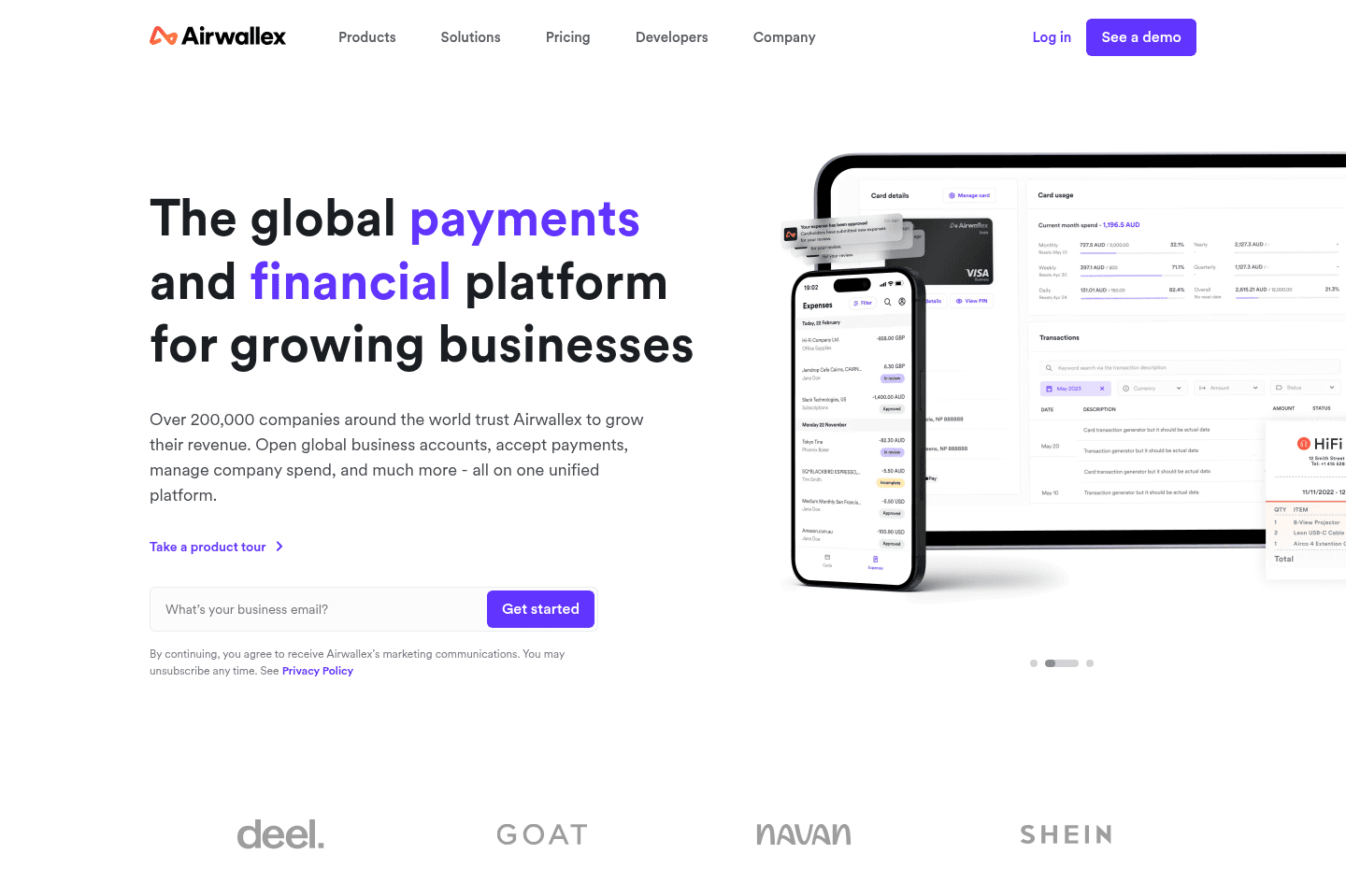
What is Airwallex?Airwallex is a global finance platform built for businesses that operate internationally. It helps companies collect payments, send payouts, and manage money across multiple currencies without relying on traditional banks. The biggest advantage is that you can receive payments in local currencies and keep those funds in that currency. That means no forced conversions and fewer FX fees when paying global vendors or contractors.
Airwallex is a great fit for global businesses like ecommerce brands selling internationally, marketplaces handling payouts, or any company paying overseas contractors.
But if your business only operates domestically and rarely deals with foreign currencies, Airwallex is probably more than you need.
Pros and Cons
Pros and ConsPros
Pros- Multi-currency accounts with local bank details
- Global payouts to 200+ countries in 60+ currencies
- Competitive FX rates compared to traditional banks
- Built-in corporate cards and expense controls that work globally
- Integrations with platforms like Shopify, WooCommerce, Xero, and QuickBooks
- Free business account
Cons
Cons- Overkill for businesses operating in a single currency
- Some advanced features geared toward global teams
Key Features
Key FeaturesMulti-Currency Accounts
Multi-Currency AccountsAirwallex lets businesses create local bank accounts in multiple currencies, including USD, EUR, GBP, and AUD. This allows companies to collect payments like a local business in different countries and hold those funds without immediate conversion.
Global Payouts
Global PayoutsBusinesses can send payments to vendors and contractors in 200+ countries using local payment rails. This usually means faster transfers and lower fees compared to traditional international wires.
Corporate Cards and Expense Management
Corporate Cards and Expense ManagementAirwallex includes virtual and physical corporate cards. They make things like spend control, budgeting, and expense tracking so much easier.
But what's really cool is that you can spend directly from foreign currency balances with Airwallex. So get paid $10k in USD and pay your US vendors in USD without ever converting the funds.
Pricing
PricingAirwallex offers a free business account, so it's super easy to get started without up-front costs. (A no-brainer!)
- Explore: Free. Best for startups and small businesses that want multi-currency accounts, global transfers, and corporate cards without paying a monthly fee.
- Grow: Paid plan designed for scaling businesses that need more advanced spend controls, expense management, and financial automation tools.
- Accelerate: Higher-tier plan built for larger companies with complex financial operations and higher transaction volumes.
In addition to subscription tiers, Airwallex charges transaction-based fees depending on how you use the platform. FX conversions typically include a tiny markup above the interbank rate, which is still significantly cheaper than most traditional banks.