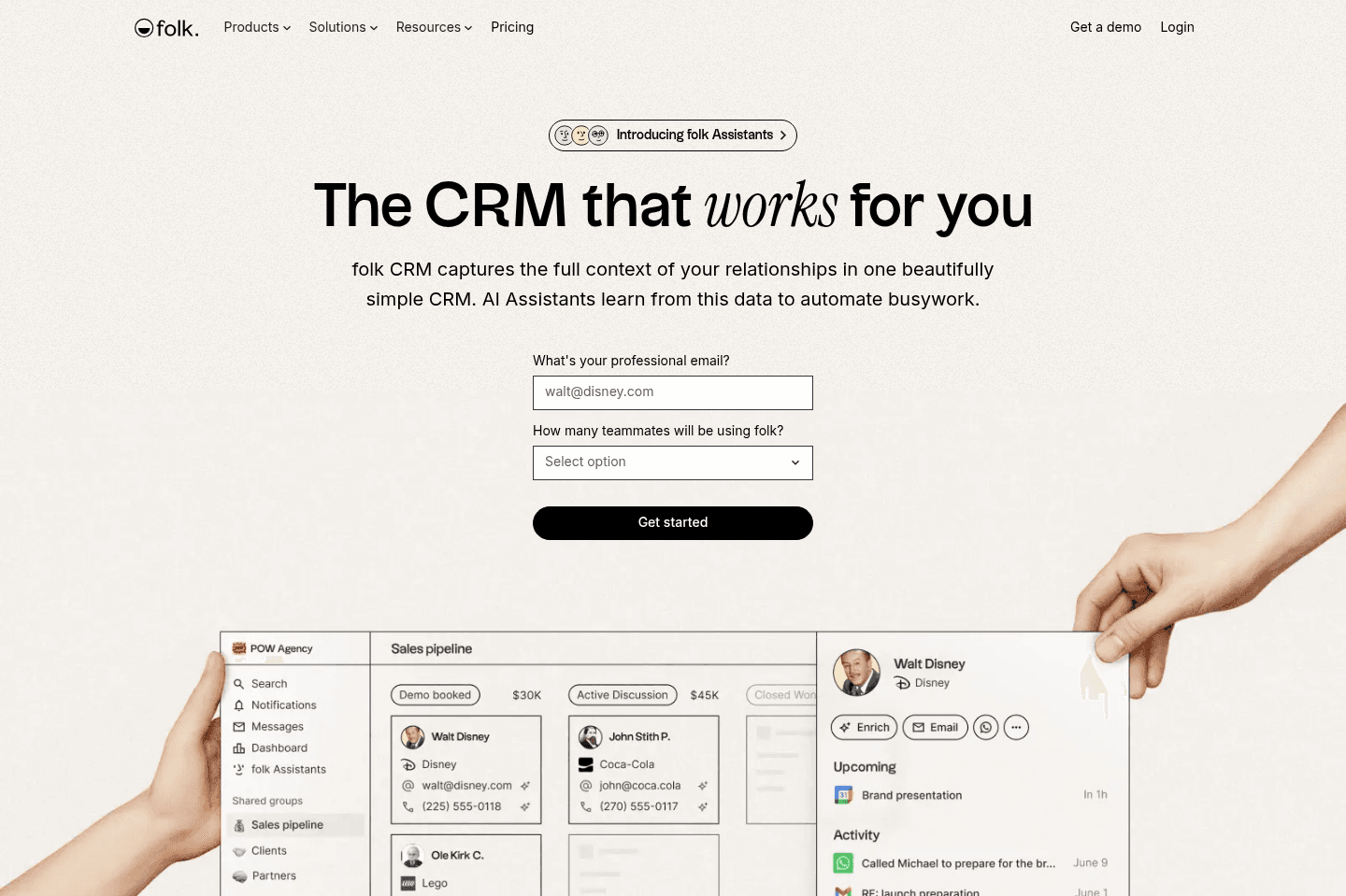
folk is a lightweight CRM that helps you manage relationships without the complexity of a traditional CRM. If you're a founder that is currently managing relationships across LinkedIn DMs, your inbox, maybe a Notion doc that is half abandoned, and you're desperately craving one place where you can see everyone you've reached out to and who you need to follow-up with, then folk is likely the right CRM for you. You can use it for something as basic as contact management or set up a deal pipeline like with any CRM.
Unlike most CRMs on this list, like Copper, or Pipedrive, or HubSpot, folk is the CRM you want to start with, especially if you have little CRM experience. If you're someone who is coming from using HubSpot or Salesforce at a previous company and are looking for your CRM that you'll use for the next 10 years, folk is probably not it. It's a beginner CRM.
It feels a lot like Notion in terms of how easy it is to get started, but with actual CRM features baked in rather than having to build everything yourself. You're not staring at a blank canvas figuring out how to structure your pipeline. The scaffolding is already there.
The Chrome extension is probably the most immediately useful part. You can pull a LinkedIn contact into folk in one click, and it auto-fills their details. If you've ever spent time manually copying someone's job title and email from LinkedIn into a spreadsheet, you'll feel that friction disappear pretty fast.
Because of that simplicity, folk is especially helpful for solopreneurs, freelancers, founders, recruiters, or small sales teams that just need a better way to stay on top of conversations and follow-ups. It gives you flexibility but adds CRM-specific features and reminders so your relationships don’t fall through the cracks.
The tradeoff with it being intentionally lightweight is that when teams are ready for deeper automation or complex integrations it's not a great tool to scale with (it has a limited API compared to other CRMs). So choose folk if you're happy with a standalone CRM and aren't trying to integrate it into every part of your process just yet.