Review Summary
Review SummarySalesforce is for enterprise teams. If you don't have at least 1000 employees, this isn't the tool for you (and for the better as there are much more exciting, user friendly CRMs for small to mid-market businesses).
Why Businesses Are Moving Away From Salesforce (Salesforce vs Copper)
Why Businesses Are Moving Away From Salesforce (Salesforce vs Copper)Salesforce Alternatives
Salesforce AlternativesNot sure if Salesforce is the right fit for you? Check out these alternatives:
 LightfieldBest
Best AI CRM
Best AI CRM WonderlyRecommended
Best for trade-services businesses with $250K+ revenue
Best for trade-services businesses with $250K+ revenue
What is Salesforce?
What is Salesforce?Salesforce is one of the most well-known CRM platforms in the world and has been the backbone of enterprise sales teams for decades. There's no denying its customizability, but just because something is well known does not mean it's right for you.
That flexibility is powerful, but it can also be really harmful for SMBs that don't have six figures (!!) to spend on hiring consultants just to handle implementation, and then more to keep it up and running.
Overall, Salesforce is incredibly capable, but it’s way too heavy. It's going to be great for large companies that need deep customization, but if that's not you, tools like Copper CRM (for Google Workspace) or even folk (if you're a sub 3 person team) are going to get the job done way better.
Or if you're looking for an AI CRM, you definitely should check out Lightfield (it's what we use, and love it).
Who is Salesforce for?
Who is Salesforce for?Very large organizations (enterprises) with complex operations are going to get the best use out of Salesforce. Companies with thousands of employees and multiple departments rely on it because it can connect all of their teams together inside a single system.
It also works best for companies that have the resources to support it. Salesforce almost always requires dedicated administrators or internal CRM teams to implement and maintain the system.
If your sales process involves long deal cycles with heavy reporting requirements and multiple stakeholders, that investment can make sense. Otherwise, the overhead usually outweighs the benefits.
Key Features
Key FeaturesHighly Customizable CRM
Highly Customizable CRMSalesforce’s biggest selling point is how customizable the platform is. You can configure just about anything if you have the time and resources.
Instead of forcing teams to adapt to a rigid tool, Salesforce adapts to the organization, which means a lot to enterprise companies with complicated operations.
But that flexibility is also exactly why it's so difficult to implement. The platform doesn't come with strong opinions about how things should be structured, which means companies have to look to consultants to design the system correctly. Without any guidance, it's easy to build something messy and overly complicated.
So, really, Salesforce is only as powerful as the team that sets it up.
AI Agents & Automation
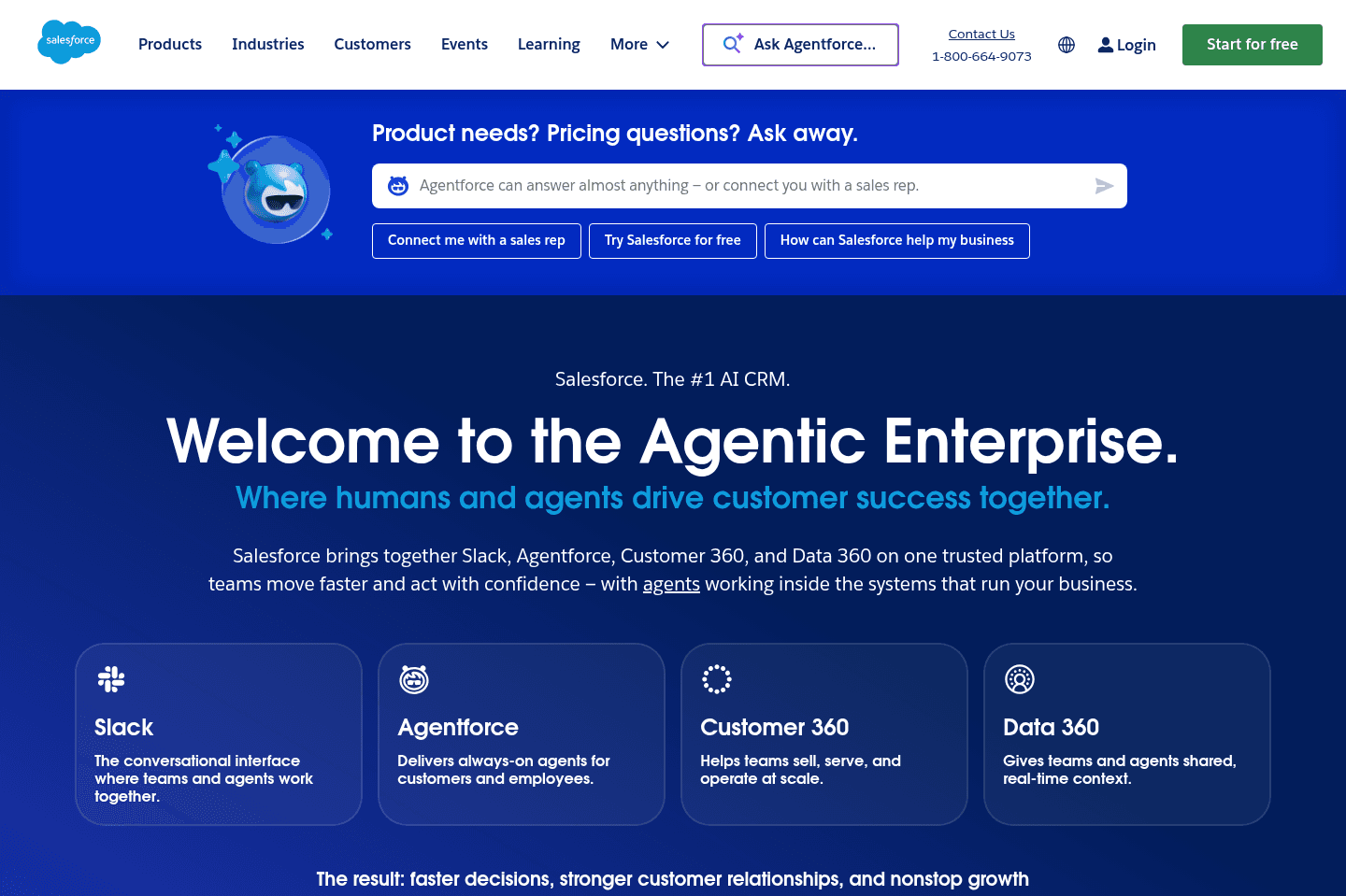
AI Agents & AutomationSalesforce has made a serious bet on AI, and it's no longer theoretical. Their agent platform, called Agentforce, is now fully deployed at enterprise scale. We're talking autonomous AI agents that can update records, trigger outreach sequences, escalate support cases, and complete multi-step workflows inside the CRM without someone babysitting every action. It's not a chatbot layered on top. It's closer to a digital worker running inside your org. We're seeing the old "Salesforce" is really becoming the data layer.
That said, the honest version of this story has some caveats. It works well when you have clean, structured data and a Salesforce admin who knows what they're doing. When those conditions aren't met (which is more common than Salesforce's marketing would suggest) deployments stall. Around 77% of B2B rollouts reportedly struggle due to data quality issues and the complexity of configuring agents to behave the way you actually want them to.
For a company managing thousands of customer records across multiple departments, this is genuinely powerful infrastructure. For a smaller team that isn't already deep in the Salesforce ecosystem, the setup cost and pricing complexity make it hard to justify. This is firmly enterprise territory for now, and Salesforce isn't really pretending otherwise.
Most CRMs built for smaller operators haven't caught up to this level of agentic capability yet, so if autonomous AI action inside a CRM matters to you, Salesforce is the most mature option on the market, just know what you're signing up for before you commit.
Sales and Pipeline Management
Sales and Pipeline ManagementYou can use Salesforce to track extremely detailed pipeline details and even build forecasting models. It really is a high-caliber tool, and it needs to be to meet its enterprise needs, but again, the level of complexity that comes along with everything can feel so overwhelming compared to modern CRM tools.
Many sales reps complain that Salesforce requires too many clicks just to update deals or log activity. That's why we're big fans of the simplicity and usability that the best CRM tools for small businesses offer.
On the plus side, Salesforce has an integration with the best email client, Superhuman Mail where you can manage your deals from within it's sleek inbox, requiring you to jump into the actual Salesforce interface less.
Additional Features
Additional FeaturesAppExchange Marketplace
AppExchange MarketplaceSalesforce has one of the largest software ecosystems in the business world through its AppExchange marketplace.
Thousands of third-party tools integrate directly into Salesforce, letting companies extend the platform with specialized functionality like finance integrations, customer support systems, industry-specific tools. If you can think of a workflow gap, there's probably an app for it.
It's not built with SMBs in mind. The costs stack up fast once you start adding third-party apps on top of an already expensive platform. But for enterprise companies building out a fully integrated tech stack, the depth of what's available here is genuinely hard to match.
Agentforce Service
Agentforce ServiceSalesforce's customer support platform (now called Agentforce Service) lets companies manage support tickets and customer communication in one place. The service layer is now built around AI agents that can handle routine queries, suggest next steps to human reps, and escalate cases automatically with full context attached.
For smaller teams, a dedicated help desk tool is going to be a simpler and cheaper path to the same outcome.
Agentforce Marketing
Agentforce MarketingWhat used to be called Marketing Cloud is now Agentforce Marketing.
Salesforce has rebuilt the marketing platform natively on their Data Cloud infrastructure, consolidating years of acquisitions into a single application with AI agents at the center.
This gives you the ability to have automated campaign creation, real-time personalization, and lead qualification that runs without someone manually configuring every step.
Whether the execution matches it in practice depends heavily on how clean your data is and whether you have a specialist to actually run it. If you're a smaller operator hoping to just plug this in, it's not going to feel that way.
Pricing
Pricing- Free Suite: $0/mo. Don't let the pricing fool you. To get the most out of Salesforce you need to properly configure it.
- Starter Suite: $25/mo per user. Best for small businesses that want core CRM capabilities.
- Pro Suite: $100/mo per user. Best for growing teams that need more advanced sales, service, and marketing functionality.
- Enterprise: $165/mo per user. Best for larger organizations that need advanced customization, automation, and integrations.
- Unlimited: $330/mo per user. Best for enterprises that want the full Salesforce platform with premier support and AI capabilities.
- Agentforce 1 Sales: $500/mo per user. Best for organizations that want Salesforce's AI-powered sales workflows and autonomous agent functionality.
Final Verdict
Final VerdictIs Salesforce worth it? For most small businesses and startups, the answer is no.
We say stay away from Salesforce as long as possible because they're an enterprise tool built for the complexity of complex operations.
If you're still figuring out your sales process or trying to stay lean, Salesforce will likely slow you down more than it helps.
Salesforce might become the right choice once your organization has grown large enough that multiple departments rely on a highly customized system, but until you reach that level of complexity, there are better tools. You should definitely at least compare Lightfield vs Salesforce to see what a modern day AI CRM can do.
Categories
CategoriesSalesforce fits into multiple categories based on what it actually helps you do. Each category highlights a different strength and the efficiency points it earned, helping you compare tools not just by features, but by how well they actually perform.
Keep exploring the best software across categories, or explore Salesforce alternatives