Review Summary
Review SummarySeveral of our past consulting clients used HubSpot, so we got a pretty good look at how different businesses were actually using it. It's powerful in some ways (marketing automation is the main reason most teams use it), but as a standalone CRM, it's not the best. Think of their CRM as a "lead magnet".
They offer it for free (or heavily discounted in the first year) to get you into their ecosystem and expose you to the rest of their features, but gets to $15–30K per year quite quickly. If you have a small team and are genuinely looking for a dedicated CRM only, there are better, more user friendly options available.
Best Small Business CRM?
Best Small Business CRM?HubSpot Alternatives
HubSpot AlternativesNot sure if HubSpot is the right fit for you? Check out these alternatives:
 LightfieldBest
Best AI CRM
Best AI CRM WonderlyRecommended
Best for trade-services businesses with $250K+ revenue
Best for trade-services businesses with $250K+ revenue
What is HubSpot?
What is HubSpot?HubSpot combines CRM, marketing automation, customer support tools, and sales software into a single ecosystem. It started as a marketing automation platform, and over time it expanded into many different tools to expand market share.
Think of their CRM as their "lead magnet". They'll give it away for free, or heavily discounted, encourage you to add all your contacts, and by the second year you end up with a $15-30K/year subscription because of all the contacts you've added and features you're using. Which heck, is totally fine if it's delivering value.
But we always like to warn businesses about that. One team we worked with originally switched from Pipedrive to HubSpot because the CRM was "free." A year later, they were spending $30k+ per year on HubSpot once they added their contacts, marketing automations, and other tools they felt they needed. They weren't quite using any features to the full extent, which didn't justify the subscription cost so then their back at square one, deciding which CRM to switch to a year later.
Not trying to downplay how powerful HubSpot is as a platform, for sure it can be. But it's not the most user friendly (to be totally honest, the projects where our clients worked with HubSpot were the ones we enjoyed least because of the clunky interface).
In the AI-era, HubSpot is not an AI-native CRM (although they are trying to claim they are). They are a traditional CRM that has been trying to keep up with the AI world. If you're a team that is truly looking for an AI-first CRM, we recommend Lightfield (it's what we use and have evaluated it heavily when we compared HubSpot vs Lightfield).
Who is HubSpot for?
Who is HubSpot for?HubSpot works best for mid-size to large companies that want a single platform to run their entire customer stack (marketing automation, CRM, customer support, etc.)
It's also the tool that companies start to consider when they're evaluating Salesforce, but want something easier to use. For a long time, HubSpot was the "modern alternative" to Salesforce, but in the AI-era we recommend Lightfield, since they are the only truly AI-native CRM available right now.
Skip HubSpot if you're a small team. If your team mainly needs a CRM and doesn't plan on heavily using complex marketing automation or customized reporting dashboards, HubSpot can will feel like overkill. If you're a small business, check out our best CRM list for alternatives.
Key Features
Key FeaturesContact & Deal Management
Contact & Deal ManagementJust like with any CRM, you get your contact and pipeline management. You can store all your customer data and interactions in one place, which gives you and overview of your relationship with each person/deal. HubSpot even has an integration with the best email client, Superhuman Mail where you can manage your deals from within your inbox.
When deals get passed between team members, so it's always helpful when someone can jump into a deal and see a contact's full history of interactions so they can pick up where they left off.
For SMBs, this part of HubSpot works well and feels familiar. The challenge is that HubSpot layers a lot of additional fields, properties, and customization on top of it. Larger teams love this flexibility (they often hire a consultant to set it up, another $20-40K cost), but for smaller businesses, it can feel like more system than you actually need.
Pipeline & Sales Tracking
Pipeline & Sales TrackingYou have the option to build customizable deal pipelines where opportunities move from stage to stage as conversations progress. This works like every other modern CRM that includes a Kanban layout. It's helpful for visibility across teams and keeps opportunities moving forward while also seeing which ones have stalled.
A huge problem is that HubSpot becomes overwhelming fast. Once you stand up automation layers and place scoring rules on top of that, everything starts to feel like overkill. That's why the "average time to fully operationalize a HubSpot product is 6 weeks!"
Most SMB teams that we've worked with just want a simple place to track deals, and that's why tools like Copper or folk stand out to us, because new tools create friction for your team, and when adoption is easier, so is the day-to-day.
Marketing Automation
Marketing AutomationTeams usually start using HubSpot to take advantage of it's robust marketing automation.
It lets you create workflows that capture leads from your website, automatically send out follow-up emails, it scores those leads depending on certain behaviors, and then routes them to your sales team when they're ready.
For example, someone scrolling on your site might see a guide that they decide to download, on the backend you can set HubSpot up to send a nurture sequence over the next few weeks, track which emails they open, and then notify your team when that person starts showing real buying intent. It's great to not have to manually manage every touchpoint, but it can also get complicated quick.
And for businesses that rely heavily on inbound marketing (SaaS companies, agencies, SEO, lead generation, etc.) having a marketing automation feature within your CRM is vital for what you're trying to accomplish. So, in those situations larger teams can justify those cost because they're offsetting them by using automation to drive higher revenue, but for most SMBs, that's just not the case.
Teams smaller than 20-30 are going to feel like it's overkill. You're not building out full funnel strategies every day and the level of complexity it takes to run those campaigns is not within your teams bandwidth. Just because a company is well known doesn't mean its right for your needs, which from what we've seen with our clients is a CRM that's makes the day-to-day easier and as a whole is simple enough to implement.
Workflow Automation
Workflow AutomationHubSpot's workflow automation does a lot. You can tell they put so much into with actions like:
- Triggering actions when certain events happen
- Creating tasks when a deal moves stages
- Assigning leads to specific reps
- Updating properties based on activity
Larger companies with full teams dedicated to the technical aspect are going to geek out and create tons of customized, intricate automations, but for SMBs, that's just not the case. A small team that's already wearing multiple hats shouldn't have to open their CRM's workflow builder and feel more overwhelmed, but that's the reality of tools like HubSpot.
User Experience
User ExperienceIf you like modern tools with clean interfaces, HubSpot will disappoint. HubSpot just feels old school. The user experience is just not anything to rave about, there is no joy in using the tool.
Because of this, you may get some silent friction from team members when trying to get them to adopt it (e.g. your sales team will not love it, you may be chasing them asking them to enter in their notes. That's the reality with most CRMs though, but especially with HubSpot as it's a bit of a maze).
HubSpot AI Features
HubSpot AI FeaturesHubSpot has really been investing in AI features lately, but like so many other companies, it's bolted-on for the most part.
While we cover HubSpot's AI features below, keep in mind that if you're at a place where you're switching CRMs, there are AI-native alternatives that we recommend (make sure to read our Lightfield Review before signing up for HubSpot).
What's important to know is that the HubSpot connector is built mostly around reading and acting on CRM data (you can look up a contact or deal, search records by property, read what properties (fields) exist and how they're defined, update the values in those fields on a given record, etc). They built these features in order to stay modern for their existing customer base.
But for new users, an AI CRM should be able to act as a consultant and set itself up (e.g. create fields and automations that are helpful to reduce busy work). HubSpot cannot be configured through AI chat, and you'll still need to hire an actual consultant to get it working properly.
This is why for new teams considering a CRM, we highly recommend checking our Lightfield first as you're going to get set up way faster (we migrated 10+ years of data in a Sunday afternoon into Lightfield, it was incredible).
Data Enrichment
A cool aspect of HubSpot's AI is that when you add a company, the AI will enrich the data for you. It automatically pulls in details like:
- What the company does
- Industry
- Estimated revenue
- Location
It even provides a short summary so your team doesn't have to go digging around Google or LinkedIn just to get basic context. This is the kind of AI we want to see more of in CRMs. It actually helps prevent data from becoming stale.
Object Summaries
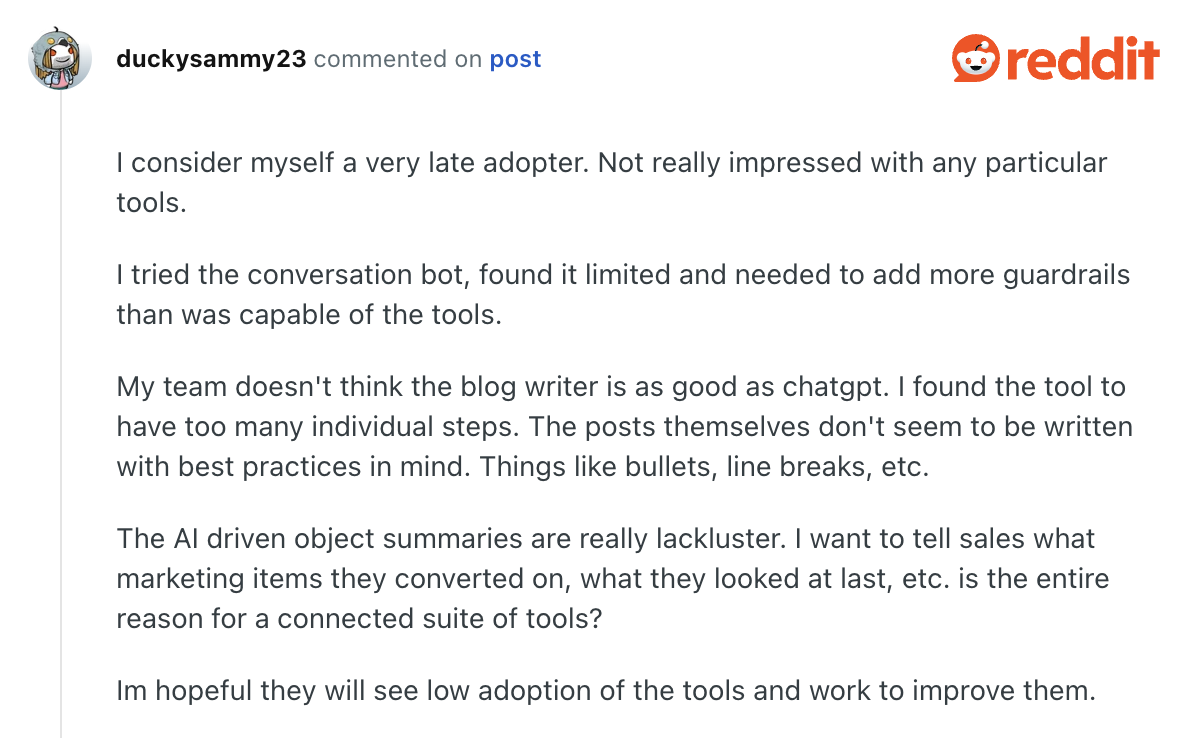
Breeze, HubSpot's AI is full of half-baked ideas, with even the simplest features, like AI-driven object summaries. It's supposed to help you jump into a record and get a high-level overview of what's going on without reading through every note or email, but that's not the case. Instead, users are saying it feels "really lackluster," only providing generic, obvious information, leading many teams to external AI tools just to get their desired results.
AI Chat
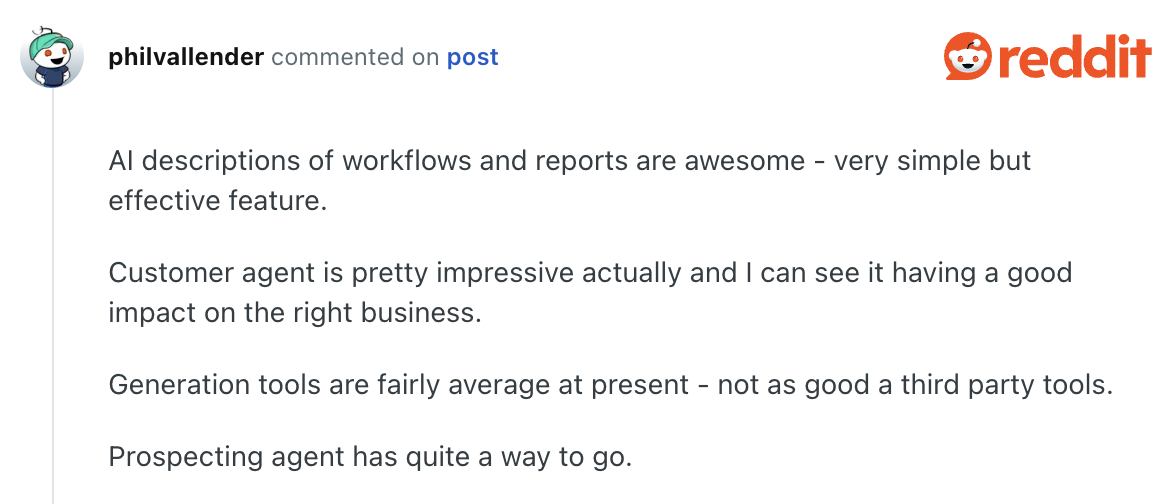
Another area HubSpot's AI seems to be making a difference is in its AI chat functionality, especially when used for customer support to handle support tickets and answer common questions. Many users are talking about how "impressive" it is and how it can really have an "impact on business." It's chats seem to be actually helping take on some of the load support teams have to carry without requiring a ton of manual setup.
The general consensus is that while the AI tools included within HubSpot are usable, and some actually helpful, they still have a way to go before they offer significant value to your teams. They're on the right track, but so far, nothing is innovative enough for you to consider using HubSpot for your SMB needs.
Additional Features
Additional FeaturesEmail Logging
Email LoggingWithin HubSpot, you're able to log conversations that you want to appear on a contact's timeline inside the CRM. You would think this is a great way to keep your team in the know with a clean record of every interaction with a prospect or customer.
However, a huge issue is that in HubSpot, the process is surprisingly fragile. For emails to log correctly, multiple things need to fall in place:
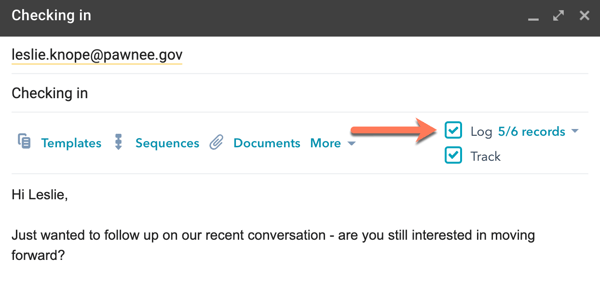
- The message must be sent through the CRM or the HubSpot extension
- Logging needs to be enabled in advance
- The contact has to already exist in the system
- The reply must come from the same connected inbox
So, for larger teams with dedicated CRM administrators, this isn't a huge deal. But for many SMB teams, this type of friction leads to inconsistent data fast. When your team has to increase their bandwidth just to log in the perfect manner, activity is going to stop getting captured. That's why we use simpler CRMs that make sure logging is automatic, so the team can turn that part of their brain off and focus on their real job.
Media Ecosystem
Media EcosystemEveryone knows how important it is to invest in media and content right now, and HubSpot is one of the most recognized CRMs because they take that seriously. They sponsor podcasts, run massive blogs, publish research reports, and have even gone as far as acquiring media brands.
They've managed to create one of the largest inbound marketing engines in the software industry, which is why they're usually the first CRM entrepreneurs find when researching tools.
Essentially, it's this situation where their visibility creates a misconception for SMBs. You start to think that because you've seen so much about HubSpot, it must be the right operational tool for your business. Don't let the FOMO deceive you, the content and media ecosystem is great and a helpful thought partner, but the platform as a whole is far more complex and expensive than what you actually need from a CRM.
Pricing
Pricing- Free CRM: $0. Best for individuals or very small teams that want basic contact management and a place to track deals.
- Starter: $15/mo. per seat. Best for small teams that want basic email marketing and simple automation.
- Professional: $890/mo. Best for growing companies that need marketing automation and advanced reporting.
- Enterprise: $3,600/mo. Best for large organizations that need advanced customizations, predictive analytics, and enterprise-grade automation.
Final Verdict
Final VerdictIs HubSpot worth it? For larger companies that have a team with bandwidth to dedicate to this powerful all-in-one platform, yes, it can be a fantastic system. But for small to medium companies, we don't think HubSpot is worth it.
If your company runs on Google Workspace, we'd recommend you check out Copper instead; it's what we've been using and loving for years. If you're on Microsoft 365, Pipedrive is also a solid alternative that includes a great, or folk if you have under 3 people on your team.
Screenshots
Screenshots
HubSpot
Categories
CategoriesHubSpot fits into multiple categories based on what it actually helps you do. Each category highlights a different strength and the efficiency points it earned, helping you compare tools not just by features, but by how well they actually perform.
Keep exploring the best software across categories, or explore HubSpot alternatives
FAQ
FAQIs HubSpot an AI CRM?
Is HubSpot an AI CRM?No, HubSpot is not an AI-native CRM. It's a traditional CRM that has added AI features (Breeze, content assistants, predictive scoring) on top of its existing platform. The data model, workflows, and automation were designed before generative AI, so AI acts as a layer rather than the foundation.
If you specifically want an AI-native CRM, one built around AI from the ground up, where the AI drives data entry, enrichment, and workflow rather than sitting on top, Lightfield is the better fit. It's designed so the CRM updates and acts on its own from your calls and emails, which is a fundamentally different architecture than HubSpot's add-on approach.