

Comparison Summary
Comparison SummaryWe wouldn't recommend Brex, read our full Brex review here to see why and check out our BILL Spend & Expense vs Ramp comparison instead.
Expense Management
Expense Management- RampBestBest
Best for startups and tech-forward businesses
Best for startups and tech-forward businesses - Brex
For startups using Capital One as their business bank
For startups using Capital One as their business bank
Billing & Invoicing
Billing & Invoicing- RampRecommendedRecommended
Best for those already using Ramp for corporate cards
Best for those already using Ramp for corporate cards - Brex
For startups using Capital One as their business bank
For startups using Capital One as their business bank
Business Banking
Business Banking- Ramp
Best if you've limited banking needs and already using Ramp
Best if you've limited banking needs and already using Ramp - Brex
For startups using Capital One as their business bank
For startups using Capital One as their business bank
- Safety & ProtectionDraw
- Earning InterestDraw
- Money MovementDraw
- Organization & ControlsDraw
- User ExperienceDraw
Comparison Videos
Comparison VideosWhy We Switched to Mercury (After Testing Every Business Bank)
Why We Switched to Mercury (After Testing Every Business Bank) 8:47
8:47Why We Switched to Mercury (After Testing Every Business Bank)
Why We Switched to Mercury (After Testing Every Business Bank) 13:10
13:10Best Expense Management Software: Ramp vs Brex vs BILL Spend & Expense vs Expensify
Best Expense Management Software: Ramp vs Brex vs BILL Spend & Expense vs ExpensifyVerdict
VerdictScreenshots
Screenshots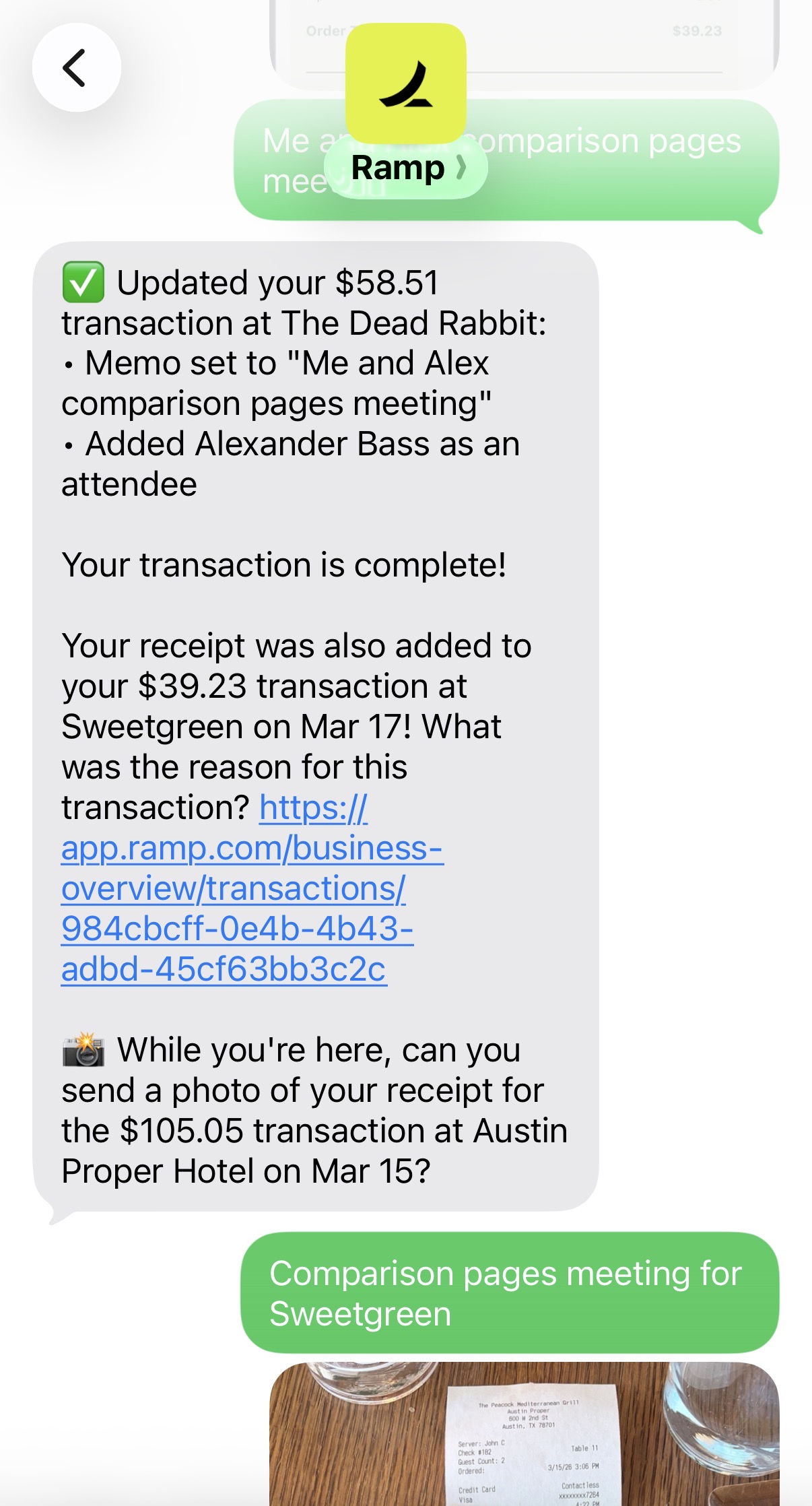

Ramp
Summaries
SummariesAlternatives
Alternatives





Ramp: Business Banking
See how Ramp compares on the most important Business Banking criteria.- Safety & Protection: 4/7
- Earning Interest: 4/7
- Money Movement: 4/7
- Organization & Controls: 3/7
- User Experience: 4/7
Ramp Editor's Verdict
What is Ramp?
Ramp is a corporate card and expense management platform designed to help companies control spend, automate finance tasks, and gain real-time visibility into expenses.
It's a leader in the spend/expense management and accounting automation space, with a clean UI/UX, tons of reporting features, and fast search functionality. Ramp is built for small teams to scaling businesses who want better financial control without the friction of traditional banks.
We've been using Ramp for about a year and love it. We're a small team of under 10 people, but have a ton of software subscriptions and Ramp makes it super easy to manage our expenses. Honestly, we hardly ever think about expense management, it just works consistently and accurately as we'd expect it to.
We also love that it feels more like a consumer app than traditional finance software. It's fast and easy to navigate, especially with features like CMD + K search on desktop to find any setting or feature, and SMS receipts while on the go.
If you’re already using something like Expensify or Brex and it’s starting to feel clunky or unreliable, you're going to be stoked with Ramp (we previously used both). And if you’re still using shared business cards like AMEX, spreadsheets, or reimbursements, your life is about to get a lot better 😄
Pros and Cons
Pros
- Easy and fast onboarding
- Clean and intuitive dashboard
- Accounting integrations (QuickBooks, Xero, NetSuite, Kick)
- Amazing receipt capture flexibility (SMS, email, mobile)
- Generous cashback rewards (~1.5%)
- iOS and Android apps
- Free
Cons
- $25K minimum balance required to open an account
Key Features
Virtual Cards & Spend Controls
We care about this one because it's come up in real life. When you run everything through one shared card, a problem anywhere becomes a problem everywhere.
With Ramp, we have a card on file with every single vendor/software subscription. If it ever gets compromised, we cancel one card, we're not spending a weekend updating payment details across every tool in the stack.
You can lock cards to specific merchants, set any limit you want, and spin up a one-off card for a vendor and close it the moment the transaction clears.
Automated Expense Management
Tap the card, get a text, reply with a receipt photo. That's genuinely the whole process for your team and no other expense management tool does it this well.
The text messages Ramp sends are friendly and easy, so even your most non-technical team member can use it. Then Ramp handles the categorization, memo, and accounting sync automatically.
Real-Time Visibility & Fast UI
Transactions show up almost immediately after a purchase, approvals come with a recommendation so you can move through them fast, and once you discover CMD+K search you'll wonder how you navigated finance software without it. It doesn't sound like much until you've used something slower.
Insights & Spend Intelligence
Ramp surfaces duplicate subscriptions, unusual spending, and cost-saving opportunities automatically. It becomes more valuable as your team and software stack grow.
Pricing
- Free: $0/mo per user. Best for startups and small businesses that want unlimited corporate cards, automated expense tracking, receipt collection via SMS/email/Slack, bill pay, and accounting integrations.
- Plus: $15/mo per user + platform fee. Best for growing companies that want AI-powered expense reviews, advanced approval workflows, multi-entity support, and deeper ERP integrations.
- Enterprise: Custom pricing. Best for large or global companies needing Workday or Oracle Fusion integrations, dedicated onboarding, and global card issuing.
Worth noting: You need around $25K in your business bank account at signup to get approved. Your credit limit will be based on your cash balance.
Brex: Business Banking
See how Brex compares on the most important Business Banking criteria.- Safety & Protection: 4/7
- Earning Interest: 4/7
- Money Movement: 3/7
- Organization & Controls: 4/7
- User Experience: 3/7
Brex Editor's Verdict
What is Brex?
Brex a spend management platform for venture-backed startups and large teams. They also have a lightweight banking product called Brex Cash that functions as a simple business checking account.
We evaluated Brex years ago while comparing corporate card platforms. At the time it looked promising, and a lot of startups were using it for business banking. But the reality is Brex isn’t really designed to be your primary business bank, it's much more of an expense management platform built for startups that have raised serious venture capital.
The product has taken a strange turn over the past few years. After onboarding a large number of small and mid-sized businesses, Brex abruptly shut down access for many of those smaller accounts (including ours! I guess we weren't "startup" enough) and repositioned the platform almost entirely toward venture-backed startups or companies doing roughly $400K+ in monthly revenue.
For that reason, Brex isn't going to be something we recommend. But even if that weren't the case, when you compare the actual day-to-day experience, especially things like UI/UX and automated expense reconciliation, newer platforms like Ramp and BILL Spend & Expense have pulled ahead for most modern SMBs.
Pros and Cons
Pros
- Designed specifically for venture-backed startups
- Virtual cards and spend controls are easy to set up
- Startup perks and partnerships (especially through YC)
Cons
- Not available to most small businesses anymore
- Accounts have historically been closed or restricted unexpectedly
- UI/UX and accounting automation lag behind competitors
- Banking features are limited compared to dedicated business banks
Key Features
Corporate Cards
Brex provides corporate cards designed for startups and larger teams. Their core offering is pretty much the same as competitors': issue virtual cards, set spending limits, and control how funds are used across different departments.
Expense Management
Transactions from Brex cards feed into expense reports, where AI categorizes purchases, matches receipts, and enforces company policies. Employees can capture receipts through the mobile app, while finance teams get instant visibility into budgets and spending across teams or projects.
Brex Cash
Brex Cash is their lightweight banking product that acts like a checking account where teams can store funds and manage company spending. It works well enough for simple use cases, but it’s fairly barebones compared to dedicated business banking platforms like Mercury, which offer much deeper banking features and integrations.
Pricing
Essentials: Free. Best for startups and small teams that want Brex corporate cards, basic expense controls, accounting integrations, and bill pay.
Premium: $12 per user/month. Best for mid-sized companies that need more advanced expense policies, approval workflows, multi-entity support, and deeper ERP or HRIS integrations.
Enterprise: Custom pricing. Designed for large global organizations that need unlimited entities, advanced implementation support, and a dedicated account manager.
Note: Brex is primarily available to venture-backed startups or companies generating roughly $400K+ in monthly revenue. Many smaller businesses will not qualify for approval.