Review Summary
Review SummaryBrex has been known for randomly shutting down accounts if you don't fit into their ICP, and since the Capital One acquired them many have left out of fear of the fate of Brex.
Why We Switched to Mercury (After Testing Every Business Bank)
Why We Switched to Mercury (After Testing Every Business Bank)Brex Alternatives
Brex AlternativesNot sure if Brex is the right fit for you? Check out these alternatives:
 RampBest
Best for startups and tech-forward businesses
Best for startups and tech-forward businesses BILL Spend & ExpenseBest
Best for small businesses
Best for small businesses MercuryRecommended
Best for all-in-one banking and expense management
Best for all-in-one banking and expense management
What is Brex?
What is Brex?Brex a spend management platform for venture-backed startups and large teams. It includes corporate cards, expense management, bill pay, business banking accounts, and financial automation tools. Brex helps companies control employee spending, automate approvals and reimbursements, pay vendors, and track all business expenses in real time.
In 2026, they were acquired by Capital One for $5 billion. On paper the deal makes sense, Capital One gains Brex's modern spend management software and startup customer base, while Brex gets the scale of a major bank.
But the reaction across the startup and fintech community has been mixed to say the least. When we found out about the acquisition we were in San Francisco, and immediately our founder friends who were using it had their head in their palms.
The acquisition price was much lower at Brex's peak valuation of roughly $12 billion peak during the fintech boom, and some founders worry that being owned by a large bank could slow innovation or eventually fold the product into a more traditional banking stack.
While the deal likely stabilizes Brex and gives it more resources, it also adds long-term uncertainty about how independent and startup-focused the platform will remain...not to mention Ramp has been absolutely dominating the expense management space, and is way better all around, so we'd say skip Brex and just use Ramp.
Who is Brex for?
Who is Brex for?Startups, technology companies, and growing businesses that want a modern alternative to traditional corporate banking and expense systems. Companies like DoorDash and Robinhood use Brex to manage company spending.
Key Features
Key FeaturesCorporate Cards
Corporate CardsBrex provides corporate cards designed for startups and larger teams. Their core offering is pretty much the same as competitors': issue virtual cards, set spending limits, and control how funds are used across different departments.
Expense Management
Expense ManagementBrex tracks spending as it happens and reduces manual accounting work. Transactions from Brex cards feed into expense reports, where AI categorizes purchases, matches receipts, and enforces company policies. Employees can capture receipts through the mobile app, while finance teams get instant visibility into budgets and spending across teams or projects.
Bill Pay
Bill PayFinance teams can upload or email invoices, automatically extract key data with AI, route them through approval workflows, and pay vendors via ACH, wire, check, or virtual card. The system can also match invoices to purchase orders and integrate with accounting tools like QuickBooks, Xero, or NetSuite to sync financial data automatically.
Brex Cash
Brex CashBrex Cash is their lightweight banking product that acts like a checking account where teams can store funds and manage company spending. It works well enough for simple use cases, but it’s fairly barebones compared to dedicated business banking platforms like Mercury, which offer much deeper banking features and integrations.
Additional Features
Additional FeaturesStartup Perks and Partner Network
Startup Perks and Partner NetworkThrough partnerships, particularly within the Y Combinator ecosystem, startups can unlock discounts on tools like AWS, software subscriptions, and other operational services.
Final Verdict
Final VerdictBrex has run into a bit of an odd situation in recent years, while focusing on growth, they apparently took on too many small-mid size businesses, which led to them axing accounts of many of their customers out of nowhere. They are now only allowing venture-backed startups onto their platform, or mid-size businesses doing at-least $400k/mo in revenue ($4.8m/yr).
We actually had a Brex account for many years when first evaluating it (checking in on how it evolved over the years), and recently, we were actually one of the many that were pulled into the axing account mess (luckily we ultimately decided on BILL Spend & Expense which we used for 5 years, then Ramp which we switched over to recently because they are building more for startups). That said, when trying to log back into my account to add some screenshots to this post, I was met with a redirection loop and the following message from support upon reaching out:
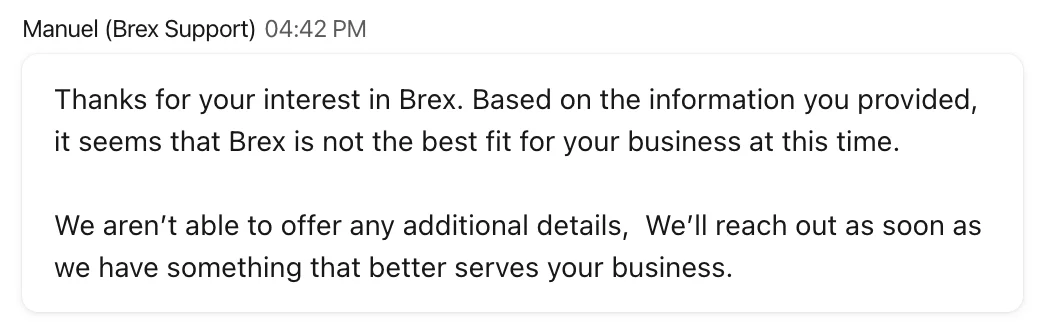
(We had an account a few years back... and then didn't; got this message when trying to regain access) 😅
All-in-all, they seem to be relying quite heavily on their YC network, getting most YC companies to use them by offering as many perks to them as possible. When actually comparing Brex against the competitors though when it comes to automatic reconciling of your expenses in your accounting software, and just overall UI/UX, there's a lot to be desired, BILL Spend & Expense and Ramp are far superior in many of those areas.
Categories
CategoriesBrex fits into multiple categories based on what it actually helps you do. Each category highlights a different strength and the efficiency points it earned, helping you compare tools not just by features, but by how well they actually perform.
Keep exploring the best software across categories, or explore Brex alternatives