
Summary
SummaryI need to say this first: Superhuman is the best email client on the market. It's wildly fast, minimal (not bloated with features), and helps individuals and teams triage through emails most efficiently. So why are you looking for an alternative?
My best guess is price. Most folks feel that Superhuman is expensive and would like something more affordable, because after all, we're all used to email being free.
So if that's the case and you haven't even tried it, here's a Superhuman Mail free trial, no harm in just seeing for yourself if it's worth it, right?
Is Superhuman Worth It?
Before we get into the alternatives, one quick story. When I heard about Superhuman, while I thought it was a cool app, my exact words were "I'll never pay for email". I refused to even try it (back then there was no free trial, you had to pay for the month upfront, without even being able to log into the app).
Alex (my partner) was a huge Superhuman fan, and he was convinced it would help improve my productivity if I just was willing to give it a shot. He said to me "try it for a month, if you hate it, then I will personally pay you back the $30 you spent on your subscription."
Well, that meant I had no risk involved, I told him I'd take him up on his offer and keep him accountable to it. But...nearly 5 years later, I am still using and paying for Superhuman. Alex never had to fork up the money, he was right, it totally changed how I view email. I LOVE Superhuman, and shudder at the thought of going back to normal email.
The minimal and beautiful interface makes emails more digestible to read. The keyboard shortcuts and phone app gestures seriously help me get through my inbox probably 4 times faster.
Features to Consider
Superhuman has so many thoughtful features that help me manage my inbox (from AI Search, ask a question in plain text about your inbox and it will answer for you, to more simple things like hitting CMD + Enter for super fast and neat in-line responding, or Inbox Splits to automatically sort emails into categories that allow for faster triaging). Most recently, Superhuman added the ability to even leave private comments for your team within each email thread.
Superhuman Verdict
So my 2 cents? I get you're looking for an alternative. That said, Superhuman Mail now has a Superhuman free trial for 30–days free (again, this was not available back in the day!). So try it first (for free), then if you don't get the productivity wins, come back to this page to consider other options.
But since we're here, what are the Superhuman alternatives?
 MissiveRecommended
Best for smaller teams looking for a shared inbox
Best for smaller teams looking for a shared inbox Spark
SparkBest free email client
Best free email client Gmail
GmailBest foundational email client for Google Workspace users
Best foundational email client for Google Workspace users Tatem
TatemLimited online presence, current development status is unclear
Limited online presence, current development status is unclear Hey
HeyMade for non-technical users who like big buttons
Made for non-technical users who like big buttons Outlook
Best for those using Microsoft 365
Best for those using Microsoft 365
 Notion Mail
Notion Mail is shutting down on Sep 22nd
Notion Mail is shutting down on Sep 22nd
Missive
MissiveBest alternative for shared team inbox management.
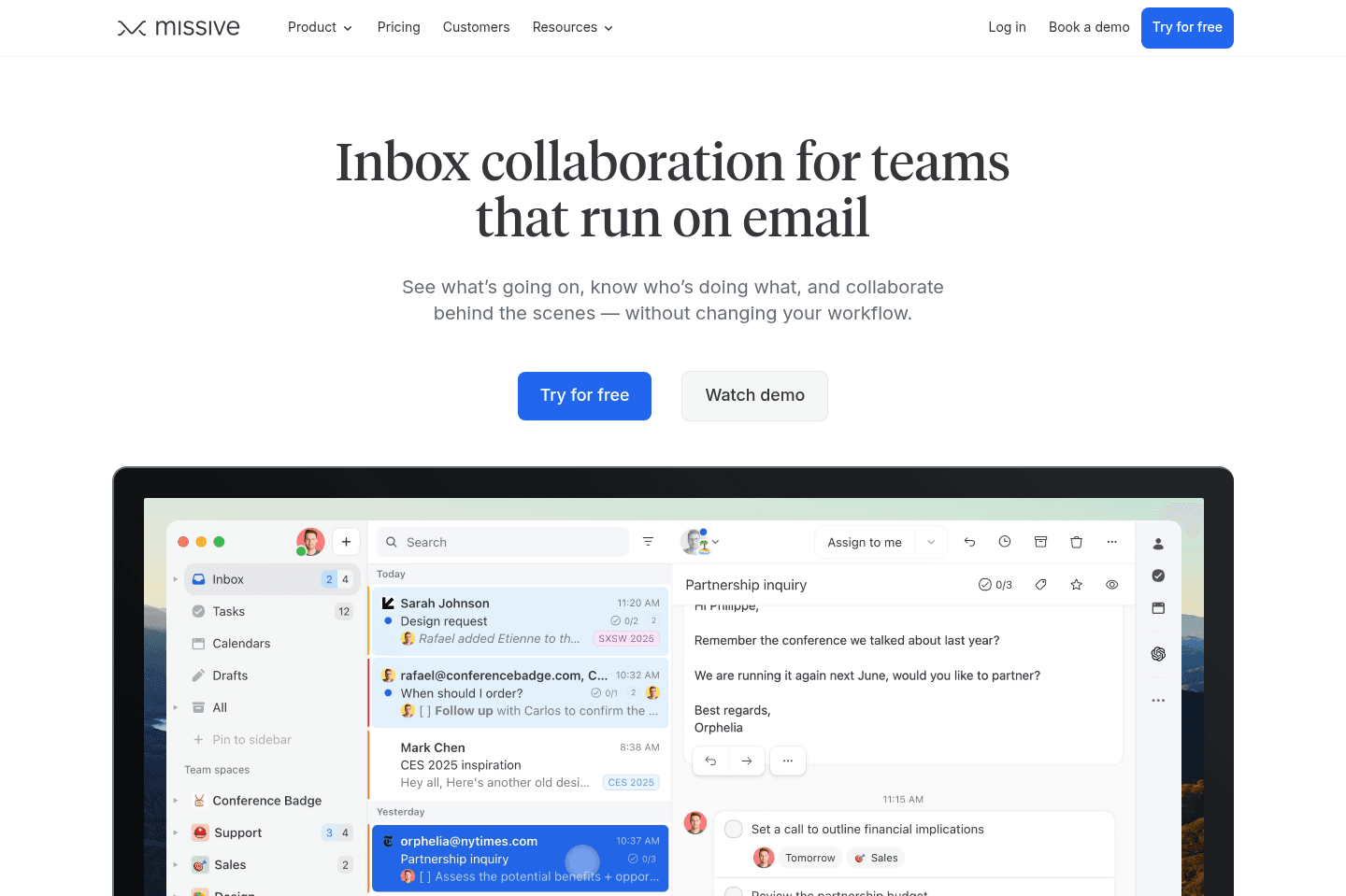
Missive is a good alternative for those who need to coordinate email and messaging across a team, especially when communication comes in through multiple channels like email, WhatsApp, SMS, and social media. If your business relies on shared inboxes or you often delegate email tasks to team members, Missive makes it easy to assign, discuss, and respond to messages without exposing your entire inbox or juggling passwords.
It's especially strong for small businesses and remote teams that want to keep all their client and internal conversations in one place, with built-in tools to assign specific emails, automate delegation, and collaborate directly on threads. If your customers reach out from everywhere and you want your team to handle everything from a single dashboard, this tool will save you from bouncing between apps and messy forwarding.
Missive is less suited for solo professionals who want a modern, streamlined personal email experience. The interface can feel a bit cluttered, and solo users may not get much value from its team-focused features.
Spark
SparkBest alternative for organized inbox management.
Spark is an alternative for those who want a cleaner, faster email experience without a steep learning curve or heavy commitment. If you're looking for something that makes your inbox less overwhelming, especially if you get a lot of newsletters and notifications, Spark's smart inbox helps sort things out right away. It's also worth considering if you want to manage multiple email accounts in one place or need simple ways to collaborate on email with a small team.
You'll get a more modern interface and some handy shortcuts, making daily email less of a chore. If you're tired of switching between tabs or apps to check different inboxes, Spark brings everything together and lets you quickly toggle between personal and work accounts.
The main limitation is that Spark isn't built for deep, keyboard-driven workflows or advanced automation, so professionals who want to move through large volumes of email as fast as possible may find it lacking. Customization is also limited, and some features are only available on certain platforms.
Gmail
GmailBest alternative for Google-centric email workflows.
Gmail is a great alternative for those who want their email to fit tightly with the rest of Google Workspace. If your team already uses Google Docs, Sheets, Drive, and Meet, Gmail keeps everything connected, letting you move between communication and collaboration without extra steps.
It's also a strong pick if you depend on integrations, Gmail connects to almost every major productivity tool and offers a stable, widely supported experience across devices. The mobile app is especially reliable for on-the-go email, with simple navigation and solid notification controls.
That said, it's definitely not the best email client available. If you need a fast, focused inbox for processing heavy email volume or want an uncluttered interface, Gmail's design and slower load times can get in the way. It's built for the broadest possible audience, not for deep work or advanced triage.
Tatem
TatemBest alternative for minimalist distraction-free email.
Tatem is an alternative for those who want a fast, ultra-minimal email client and don't need a lot of extra features. If you value a clean interface without visual clutter and just want to process email quickly, Tatem's stripped-down approach makes it easy to focus on your inbox without distractions.
Just be aware that Tatem's future is uncertain after its recent acquisition. If you need a long-term, actively maintained email solution, this may not be the right fit.
Hey
HeyBest alternative for simplified personal email.
Hey is an alternative for those who want a fresh start with email and prefer a simplified, opinionated approach over traditional business tools. If you're looking to leave behind corporate platforms and don't rely on integrations, Hey's screening system and unique inbox structure can help you cut back on spam and keep your messages organized in a way that feels less overwhelming.
If you like big buttons, bright colors, and don't need advanced productivity features or connections to other apps, Hey's design and workflow may be a good fit for your personal email. It's especially appealing if you want a clean break from Google or Microsoft and don't mind sharing a new @hey.com address with your contacts.
This isn't the right choice for business users or anyone who depends on integrations, custom workflows, or APIs. Once you switch, you're locked into Hey's ecosystem and approach, so it's best for those who value simplicity over flexibility.
Outlook
OutlookBest alternative for Microsoft-based enterprise email.
Outlook is an alternative for those who work in larger organizations that are already committed to the Microsoft 365 ecosystem. If your team relies on Microsoft tools like Word, Excel, Teams, or SharePoint, Outlook keeps your email and calendar in one place and connects smoothly with the rest of your workflow.
It's especially suited for environments where enterprise security, compliance, and centralized administration are a priority. You'll find the interface familiar if you've used Microsoft products before, and it's dependable across desktop, web, and mobile.
If you want a modern or lightweight email experience, or your team depends on lots of integrations with newer SaaS tools, Outlook can feel a bit clunky and limited. Smaller or fast-moving teams may find it more complex than necessary.
Notion Mail
Notion MailImportant: Notion Mail shut down September 22nd, 2026.
For a limited time, Superhuman Mail is giving our audience an exclusive 2 months extended free trial to any Notion Mail users affected. You can claim the extended Superhuman Mail 2 month free trial here.
Notion Mail was formerly an alternative for those who already rely on Notion and want a cleaner, more organized Gmail experience with some added AI tools. If you're a Notion user who values referencing Notion pages while drafting emails or likes the idea of customizing inbox views, this tool can make your inbox feel less cluttered and more visually streamlined.
Before, you'd benefit most if your workflow centers around Gmail and you occasionally want to pull in Notion content to help write emails. The interface is designed to be minimal and supports keyboard shortcuts for most actions, which can help speed up triage for light to moderate email loads.
Notion Mail wasn't suited for those who needed deep integration with Notion databases, advanced team features, or a mobile app. It also wasn't a fit if you use Outlook or expected AI that adapted to your writing style.
Videos
VideosBest Email Client: $0 vs $400 Email
Best Email Client: $0 vs $400 Email 26:19
26:19Best Email Client: $0 vs $400 Email
Best Email Client: $0 vs $400 Email 16:24
16:24Notion Failed You
Notion Failed You