
Summary
Summary MotionBest
Best AI project management for small-mid-size teams
Best AI project management for small-mid-size teams LinearBest
Best for engineering teams
Best for engineering teams AsanaRecommended
Best for enterprise teams
Best for enterprise teams Monday
Highly customizable, for complex projects and large teams
Highly customizable, for complex projects and large teams Wrike
WrikeFor enterprises who want deep reporting and analytics
For enterprises who want deep reporting and analytics Trello
For extremely basic task management and very small teams (<3)
For extremely basic task management and very small teams (<3) Jira
JiraFor large enterprises, often disliked by teams
For large enterprises, often disliked by teams Shortcut
For teams already locked into Shortcut for other use-cases
For teams already locked into Shortcut for other use-cases
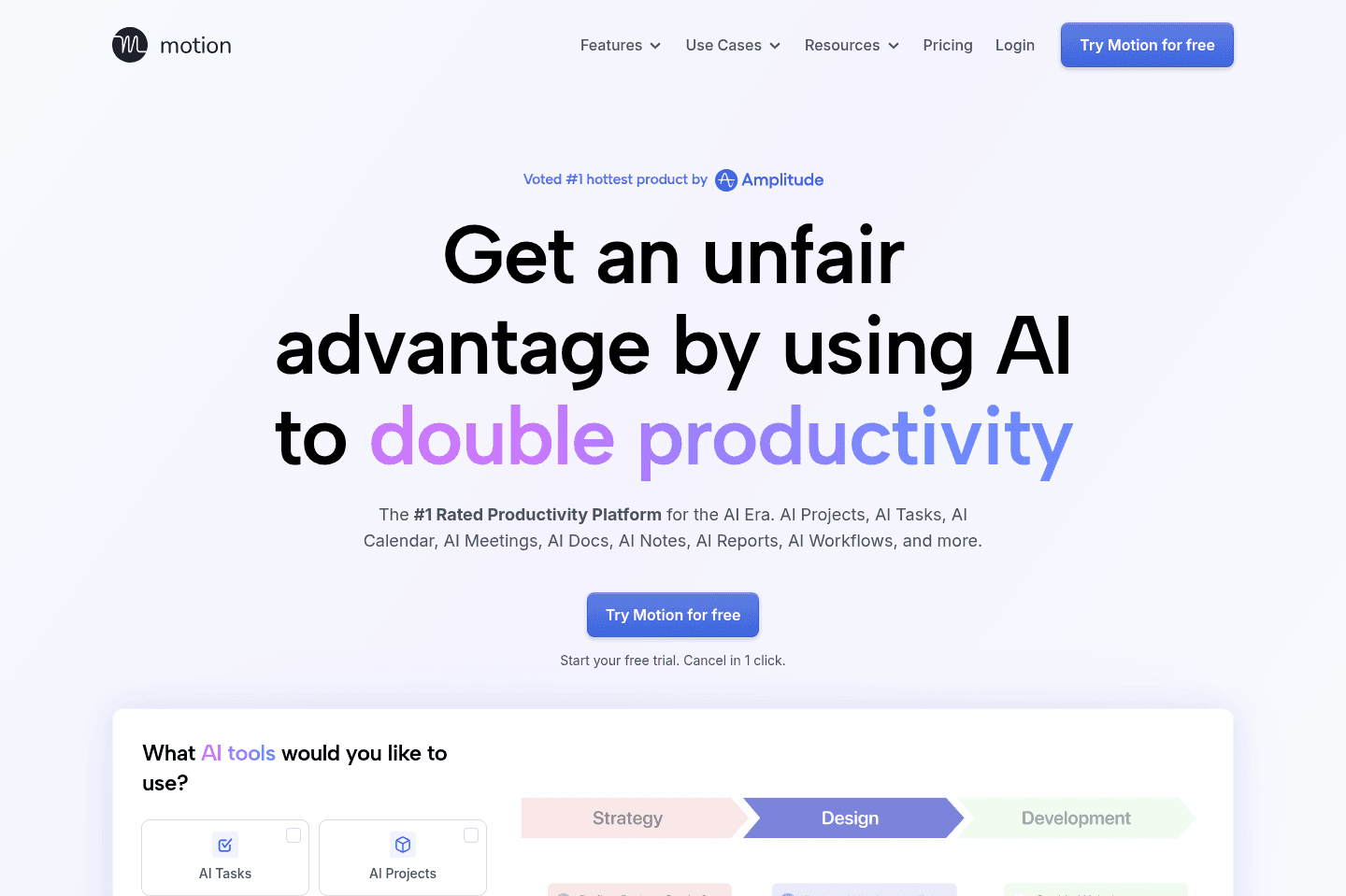
Motion
MotionBest alternative for calendar-driven AI project management.
Motion is a great alternative for those who want their project management tool to take the hassle out of scheduling and prioritization. If you're tired of constantly updating deadlines or figuring out what to focus on next, Motion stands out by automatically organizing your team's tasks directly onto your calendar, adjusting as meetings and priorities shift. It's actually one of the first AI tools our team adopted.
This approach is especially useful for small to mid-sized teams, busy professionals, or freelancers who want to spend more time working and less time managing their workflow. Motion also brings meeting notes, documentation, and workload tracking into one place, making it easier to keep everything connected without jumping between tools.
If you prefer to control every detail of your schedule yourself or need advanced reporting and dashboards, Motion may not be the best fit. It's also not designed for large enterprise environments.
Linear
LinearBest alternative for engineering-led project tracking.
Linear is a great alternative for those who need to manage projects centered around engineering and product workflows. If your team is mostly engineers, product managers, or designers, Linear makes it easy to tie together bugs, feature requests, and sprints with minimal setup. Teams often find onboarding quick, with most engineers able to use it right away without extra training, and integrations with tools like Slack and CLI access help keep everything in sync.
If your organization is mainly product-focused, you might be able to use Linear as your primary project manager. Adoption tends to be strongest among technical teams, who often express real satisfaction with the tool.
Linear is not built for marketing, sales, or broader company-wide project management. If you need a tool that works for every department, you'll likely need to pair it with something else.
Asana
AsanaBest alternative for traditional project management.
Asana is a great alternative for those who need a stable, well-established platform to manage complex projects with multiple team members and stakeholders. If your workflow involves detailed tracking, custom fields, workload balancing, and advanced reporting for upper management, Asana stands out for its reliability and depth.
It's especially suited for organizations with a dedicated project manager who can invest time in setup and ongoing maintenance. If you're running projects where oversight, regular updates, and capacity planning are core to your process, Asana provides the structure and tools to support that.
To get real value, you'll need to budget for a paid plan and possibly professional setup help. If your team is small or you want a tool that handles scheduling and time management with less manual effort, Asana's approach may feel too involved.
Monday
MondayBest alternative for customizable enterprise workspaces.
Monday is an alternative for those who need a project management tool that can be tailored to handle complex workflows across large teams. If your projects require building out detailed dashboards, custom charts, or connecting with other enterprise software like Jira or Salesforce, Monday can support those needs, especially when you have a dedicated project manager to handle setup and ongoing management. The interface is visually engaging, and there are multiple ways to view and organize your project data, which can help with internal reporting and resource management.
If you're working with a team of over 300 people and have the resources to invest in proper onboarding, possibly even bringing in a consultant, Monday can flex to fit demanding project structures. It's also a fit if collaborating with external partners is central to your workflow.
The main limitation is that Monday's flexibility comes with a steep learning curve and setup process. Without serious investment in implementation, most teams find it overwhelming or underused, and smaller teams may find it too much work for the payoff. If you want something quick to set up or need high reliability out of the box, Monday likely won't be the best choice.
Wrike
WrikeBest alternative for complex enterprise projects.
Wrike is an alternative for those who need to manage large, multi-layered projects across big teams and require deep customization. If your organization depends on detailed reporting and needs to connect with enterprise tools like Salesforce or SAP, Wrike stands out for its advanced analytics and strong integrations.
However, Wrike's interface can be challenging to learn, and it's best suited for enterprise companies with over 1000 employees. Smaller teams will likely find it too complex for their needs.
Trello
TrelloBest alternative for simple board-based tracking.
Trello is an alternative for those who want a straightforward kanban board to manage personal tasks or small projects, especially if you value a familiar interface that hasn't changed much over the years. If your workflow relies on the Atlassian suite, like Jira, Confluence, or Bitbucket, Trello's native integrations can make it a practical choice for keeping everything connected.
If you need advanced project management features or a tool that keeps pace with modern design and innovation, Trello will likely feel dated and limited. It's best suited for basic use cases or teams already committed to the Atlassian ecosystem.
Jira
JiraBest alternative for complex enterprise agile workflows.
Jira is an alternative for those who need to manage large-scale software projects with traditional agile methods in a highly technical, enterprise environment. If your team already operates with systems like Salesforce or NetSuite and you have dedicated staff, such as full-time Scrum Masters, to oversee project coordination, Jira can support detailed workflows, cross-department collaboration, and task assignment at scale.
This tool makes the most sense if you have thousands of employees and the resources to handle a steep learning curve, regular training, and potentially custom integrations. It's built for organizations where project management is a specialized role, not a side task.
If you're a smaller team, want an easy setup, or need a tool for non-engineering departments, Jira's complexity and user experience will likely get in the way. Expect low adoption and frustration unless you have the budget and commitment for ongoing support.
Shortcut
ShortcutBest alternative for for teams already locked into Shortcut for other use-cases.
Shortcut is an alternative for those who want a project management tool that has been around for years and are comfortable working with a platform built on a legacy tech stack. If your workflow depends on stability and you don't need the latest design or features, Shortcut fits.
If you are looking for a modern, cutting-edge project management experience, Shortcut's older technology and accumulated tech debt may not meet your needs.

Notion
NotionBest alternative for flexible team wikis.
Notion is an alternative for those who want a highly customizable workspace to build out a company knowledge base or internal wiki. If you prefer having control over the structure and enjoy setting up your own systems for documentation, Notion gives you the flexibility to tailor everything from note linking to database layouts.
Notion works if you want a blank canvas to organize information your own way. If you value flexibility over ready-made tools, Notion can be a good fit for you.
If you're looking for something with built-in guidance (recommended for businesses) or want to avoid the time investment of building from scratch, skip Notion.
Videos
VideosNotion Failed You
Notion Failed You 16:24
16:24Notion Failed You
Notion Failed You 12:36
12:36Best Project Management Software? Motion vs Asana vs ClickUp vs Monday vs Notion
Best Project Management Software? Motion vs Asana vs ClickUp vs Monday vs Notion