Comparison Summary
Comparison SummaryRamp fixes annoying expense reports and streamlines corporate card use, while Relay focuses on helping owners organize cash flow using Profit First buckets.
Only use Relay if you specifically want cash flow buckets, but choose Ramp for smoother expense management in any modern business.
 RelayRecommended
Profit-First style money management
Profit-First style money management Ramp
RampBest if you've limited banking needs and already using Ramp
Best if you've limited banking needs and already using Ramp
At a Glance
At a GlanceComparison Video
Comparison VideoWhy We Switched to Mercury (After Testing Every Business Bank)
Why We Switched to Mercury (After Testing Every Business Bank) 8:47
8:47Why We Switched to Mercury (After Testing Every Business Bank)
Why We Switched to Mercury (After Testing Every Business Bank)Editor's Verdict
Editor's VerdictSafety & Protection
Safety & ProtectionRamp gives you more control over who can pull money from your account, letting you require approval for external ACH debits and even set up granular rules. The catch is, if you don't approve a debit in time, the money can still leave your account first and then get reversed, so it's not bulletproof. Still, it's a better safeguard than just handing out your account numbers and hoping for the best.
Relay works just like a regular bank when it comes to ACH pulls: anyone with your routing and account number can try to take money out, and there's no extra layer to stop it before it happens. That's the main weak spot, there's less protection against unauthorized transfers. Both Ramp and Relay spread your money across multiple banks for higher FDIC insurance, so you're covered on that front either way.
If you care about blocking unauthorized transfers, Ramp has a slight edge thanks to its approval controls, even if they aren't perfect. Relay is more like traditional banking, so you're more exposed if someone gets your account info. Neither is flawless, but Ramp gives you more tools to limit unwanted withdrawals.
Earning Interest
Earning InterestRamp gives you access to actual treasury options like government money market funds and short-term fixed income, but it feels more like a side feature bolted onto their main expense platform, not a seamless banking experience. Still, you can park idle cash in higher-yield vehicles if that matters to you.
Relay just offers a basic savings account with rates that depend on your subscription plan. You're not getting treasury funds or anything close, and the yield is lower, especially on the free plan. If you're sitting on a lot of cash, Relay's setup means you're leaving money on the table.
If earning serious interest on idle business cash is your priority, Ramp is the stronger pick here, even if the experience isn't totally streamlined. Relay is simpler but just can't match the yield potential.
Money Movement
Money MovementRelay makes it much smoother to pay bills thanks to its automatic extraction of invoice details from emails, so you skip a lot of manual entry. That alone saves time, especially if you're handling a bunch of vendor payments. Plus, Relay lets you create, send, and track invoices directly, which means you don't need another tool just to get paid.
But Relay drops the ball on vendor onboarding since it won't collect W-9s for you. If you have a lot of contractors, that's annoying busywork at tax time, you'll be chasing everyone down yourself.
Ramp covers the basics for payments (ACH, wires, checks, vendor management) and works fine for day-to-day needs. But as soon as you try to use it for more, especially if you rely on modern accounting tools, things get messy. For example, Ramp's integrations might only cover credit card stuff, not bill pay or invoicing, which leaves gaps if you want everything connected.
If you just want to move money and avoid manual bill entry, Relay has the edge. But if collecting tax info automatically is a dealbreaker, neither one nails it, Relay makes you do it by hand, and Ramp doesn't even mention handling W-9s. Bottom line: Relay is a bit more streamlined for paying and tracking vendors, but expect extra admin when it comes to tax details. Ramp is decent but feels more like a supplement than a full banking solution for payments.
Organization & Controls
Organization & ControlsRelay stands out for giving you true banking controls: you can open up to 20 checking accounts per business, nickname them for different purposes, and set up percentage-based auto-transfer rules to move money between those accounts automatically. If you want to follow "Profit First" or similar cash management methods, Relay makes it easy to structure your funds and automate how money flows between your buckets.
Ramp, on the other hand, is more limited here. You can open multiple Ramp Business Accounts, but all the cards are tied to the entity, not individual deposit accounts, and you don't get real "bucket accounts" with dedicated debit cards. Its automation rules are basic, mostly about maintaining a certain balance in your Ramp account, not distributing funds by percentage across buckets.
Both apps let you manage multiple business entities under one login and offer user roles and permissions, but Relay's controls are more granular. You can restrict team members to specific accounts and set up bill approval workflows based on dollar amounts, which is perfect for teams needing oversight. Ramp does have approval flows, but they're less flexible and don't allow for bank-wide transfer rules.
If you care about organizing funds across multiple accounts, automating transfers, and granular team controls, Relay is the clear choice. Ramp just doesn't give the same level of structure or automation for banking needs.
User Experience
User ExperienceRelay has a clear advantage for business banking user experience. Its interface is built for banking first, so everything is easy to use, the dashboards stay simple and uncluttered, and setting up things like auto-transfers is straightforward.
Ramp looks great and searching is fast, but most of its interface is focused on expense management instead of banking. You can tell banking is just an add-on, so it doesn't feel as direct or purpose-built when you need to handle banking tasks.
If what you care about is a clean, obvious banking experience, Relay is the one to pick. Ramp is polished, but it's just not as banking-focused.
Screenshots
Screenshots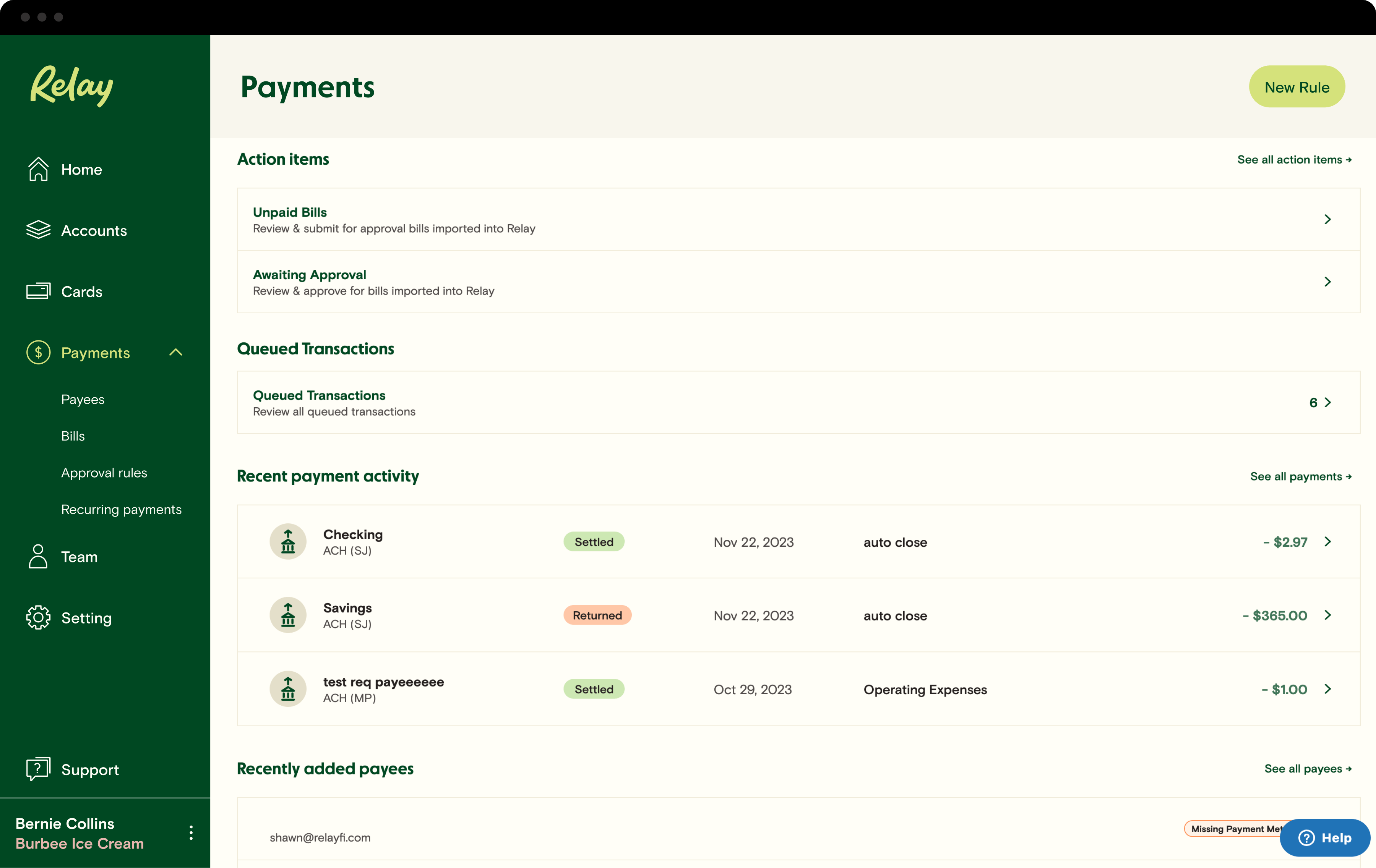


Relay