Comparison Summary
Comparison SummaryRelay works for smaller service-based business owners, while Rho tries to do a lot but only does some things well.
Stick with Relay if you fit its target, and avoid Rho unless you need its extra features and can live with the tradeoffs.
 RelayRecommended
Profit-First style money management
Profit-First style money management RhoRecommended
Built for larger funded businesses
Built for larger funded businesses
At a Glance
At a GlanceComparison Videos
Comparison VideosWhy We Switched to Mercury (After Testing Every Business Bank)
Why We Switched to Mercury (After Testing Every Business Bank) 8:47
8:47Why We Switched to Mercury (After Testing Every Business Bank)
Why We Switched to Mercury (After Testing Every Business Bank) 2:42
2:42Best Business Bank Accounts: Mercury vs Brex vs Novo vs Relay
Best Business Bank Accounts: Mercury vs Brex vs Novo vs RelayRecommended Alternatives
Recommended Alternatives MercuryBest
Best modern bank for SMB's and startup founders
Best modern bank for SMB's and startup founders Ramp
RampBest if you've limited banking needs and already using Ramp
Best if you've limited banking needs and already using Ramp
Editor's Verdict
Editor's VerdictSafety & Protection
Safety & ProtectionBoth Rho and Relay act like traditional banks when it comes to blocking unauthorized transfers. Once someone has your routing and account numbers, either app lets ACH debits through without requiring you to approve each one, so you're left monitoring and disputing after the fact. Neither gives you those extra controls businesses usually want to actually block unwanted pulls.
The real separation is in FDIC protection. Rho splits your funds across a massive sweep network, covering up to $75 million per entity, which is way more than Relay's $3 million cap. If you're holding large balances and care most about insurance limits, Rho is the obvious pick. But if you only care about unauthorized transfer controls, neither is strong, they both fall short there.
So, for big balances, Rho is the clear winner on safety. For stopping unauthorized pulls, neither really delivers.
Earning Interest
Earning InterestRho gives you actual Treasury options with auto-sweep rules, so you can park idle cash in higher-yield accounts and still keep what you need liquid. The catch is you need at least $350K to even get started, which shuts out most early business owners.
Relay is much simpler but way less lucrative. You just get a savings account with a variable interest rate, and unless you're paying for a higher plan, the returns are lower. There's no Treasury, no multi-pool strategy, and no way to optimize yield for larger balances.
If you've got enough cash to clear Rho's minimum, it's the clear winner for earning real interest. Relay is only fine if you're small and don't mind missing out on bigger returns. For maximizing idle cash, Rho is the obvious pick here.
Money Movement
Money MovementRho stands out for money movement if you deal with a lot of contractors or need to keep tax paperwork organized. It automates W-9 collection and 1099 filing, so you're not chasing vendors for info or scrambling at tax time. Rho also lets you send checks with physical attachments, which is a lifesaver if you have to mail paperwork along with payments.
Relay makes bill entry easy with solid document recognition and quick review, but it skips vendor onboarding and doesn't handle W-9s for you. That means more manual admin when tax season hits. You also can't send physical documents with checks, which adds friction if you need to include forms with mailed payments.
If you just want fast invoice entry and online payments, Relay is fine. But if you need to actually onboard vendors, collect tax info, and handle the messy real-world stuff like mailing checks with attachments, Rho is the clear choice.
Organization & Controls
Organization & ControlsRelay edges out Rho when it comes to organizing funds and controlling how money moves, especially if you care about automating your cash management with "Profit First" or percentage-based rules. Relay actually lets you set up those auto-transfer rules so funds get split up automatically across up to 20 checking accounts, which is a big deal if you want your finances to run on autopilot. Rho only does fixed-amount transfers, so you'd have to move money around manually if you want anything more complex.
Both let you manage multiple business entities under one login and offer granular team permissions, so you're covered on controlling access either way. Rho does go a bit deeper with payment approval workflows, letting you set up multi-step sign-offs on any outgoing payment, not just bills. Relay's approvals are only for bill payments, so if you need broader payment oversight, Rho has the advantage.
But if your main priority is structuring your business funds and automating how money moves, Relay is the clear pick. Rho's manual workarounds just can't match Relay's built-in automation for organizing cash across accounts.
User Experience
User ExperienceRelay stands out for user experience thanks to its simple, uncluttered interface and intuitive dashboards, making it easy to use, especially for setting up auto-transfers with Profit-First banking. The clean design keeps things straightforward.
Rho works well for finance teams but feels much denser for business owners or founders, so it's not as clear or streamlined as Relay.
If you want a banking app that's quick to pick up and easy to navigate, Relay is the better pick here. Rho is fine if you're more finance-focused, but Relay just makes day-to-day banking smoother for most people.
Screenshots
Screenshots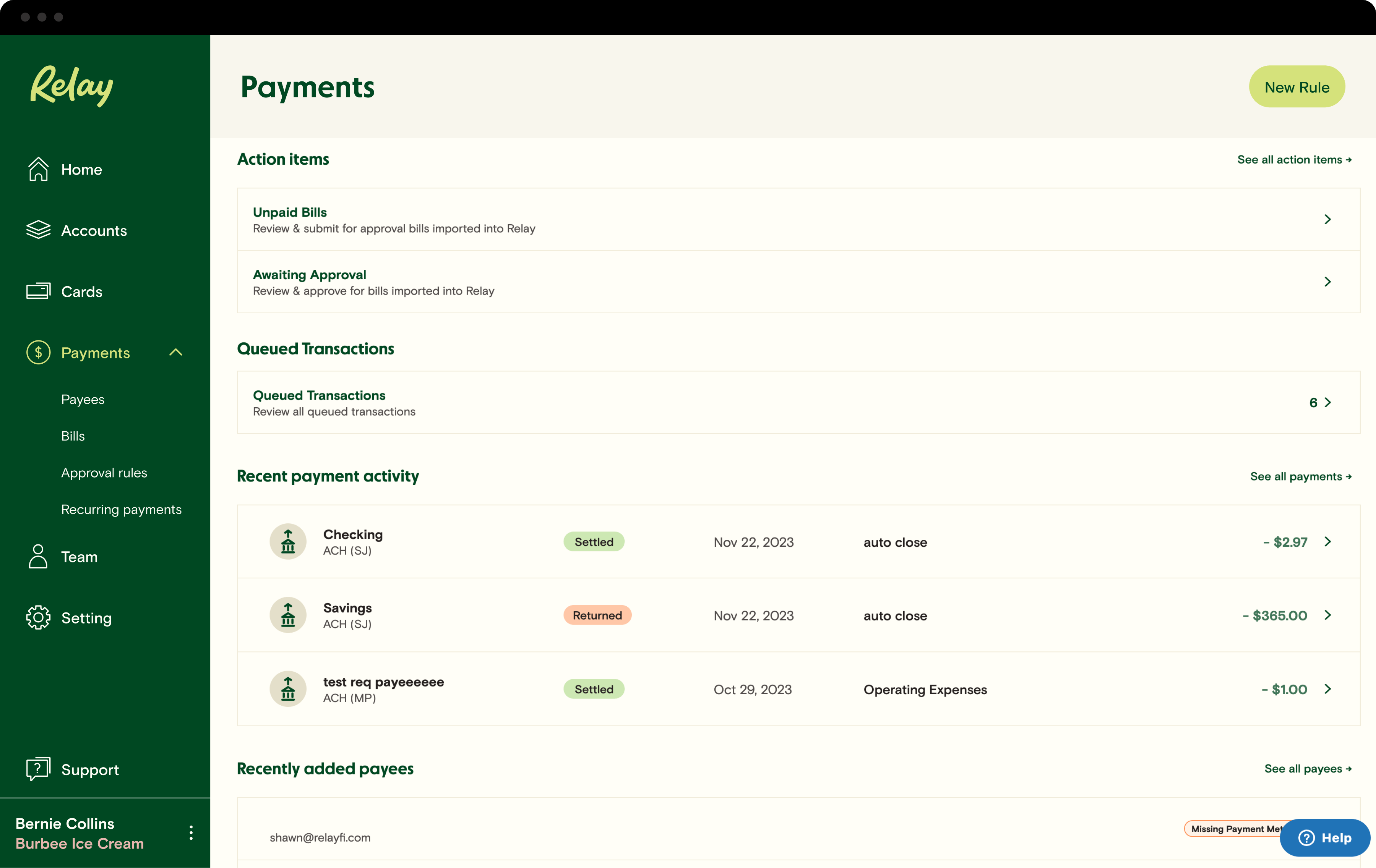
Relay