
Summary
Summary MercuryBest
Best modern bank for SMB's and startup founders
Best modern bank for SMB's and startup founders RhoRecommended
Built for larger funded businesses
Built for larger funded businesses Novo
NovoSimple and least powerful
Simple and least powerful
Mercury
MercuryBest alternative for modern business banking.
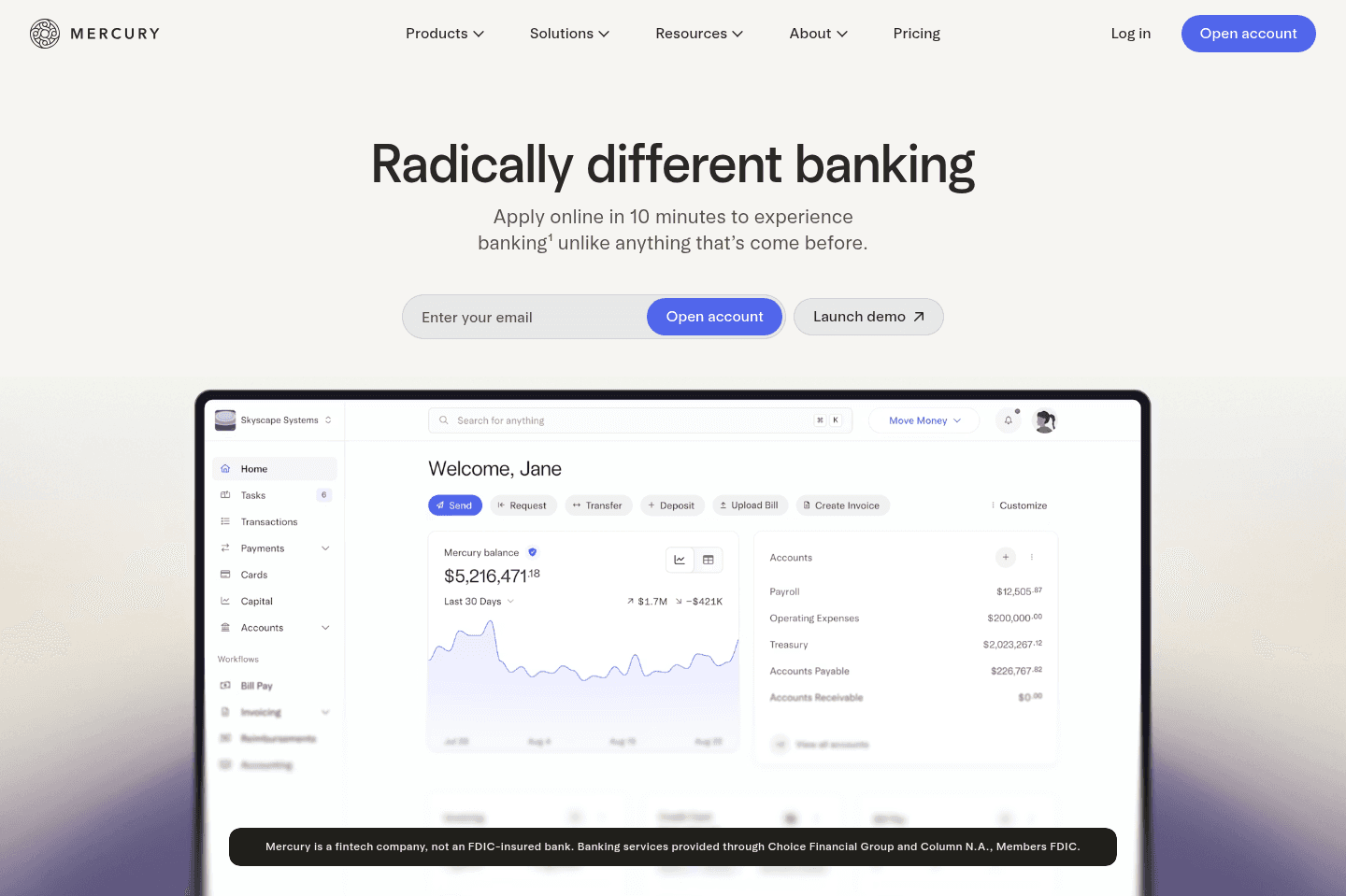
Mercury is a great alternative for those who want a banking platform that feels like software, not paperwork. If you're running a US-based business, whether you're a startup, small business, or scaling up, Mercury makes it easy to open accounts online, manage funds with automated transfers, and handle invoicing or bill pay without the usual friction. The interface is intuitive, and you can create multiple accounts to automate how money moves for payroll, taxes, or other needs.
If you want business and personal finances under one roof, Mercury stands out by offering free personal accounts to both owners and employees, making transfers between business and personal funds fast and simple. Security and FDIC insurance are handled through partner banks, so your funds are covered up to $5 million.
Mercury is online-only, so if you need physical branches or write paper checks regularly, it may not cover every edge case. Customer support isn't instant, and there's no traditional checkbook, but for most modern operators, it delivers a smoother experience than legacy options.
Disclaimer: Mercury is a fintech company, not an FDIC-insured bank. Banking services provided through Choice Financial Group and Column N.A., Members FDIC. Deposit insurance covers the failure of an insured bank.
Novo
NovoTraditional Business Banking Experience.
Novo is an alternative for those who want a business bank with a more traditional set of banking features. If you prefer straightforward business checking and don't rely on deep accounting software integrations, Novo covers the basics and feels familiar to those coming from legacy banks.
If your workflow depends on smooth QuickBooks Online integration and auto-matching, Novo's approach can be a headache. The sync method skips standard bank feeds, which breaks some of the convenience you might expect from connected accounting tools.

Ramp
RampBest alternative for scaling business expense control.
Ramp is a great alternative for those who want fast, hands-off expense management built for growing teams. If you're running a startup or mid-sized business and need to issue cards to employees, track spending in real time, and integrate directly with accounting software, Ramp makes it easy to get started without the friction of traditional banks.
The platform stands out for its quick onboarding, intuitive dashboard, and flexible receipt capture options, including SMS, email, and mobile. Finance teams who want to avoid manual reconciliation and get useful spend insights without micromanaging budgets will find Ramp especially useful. If you have a distributed team, the ability to see all spending and get alerts for cost-saving opportunities helps keep everything visible as you scale.
You'll need at least $25K in your business bank account to get approved, so Ramp is best suited for companies with steady cash flow. Smaller businesses or those with less cash on hand may find this requirement limiting.

Brex
BrexBest alternative for venture-backed startup expense control.
Brex is a great alternative for those who run venture-backed startups or larger, fast-growing teams and need a spend management platform built around that specific profile. If your company is bringing in at least $400,000 per month and wants to issue corporate cards, set tight spend controls, and access perks tailored to the startup ecosystem, Brex fits that mold. The system is especially known for integrating with platforms popular among startups and providing easy access to virtual cards and basic expense management.
If you are a small business without significant venture funding, Brex is unlikely to approve your account. For teams that need deeper banking features or more polished automation in expense management, the platform may feel limited and less refined than others in the market.
Video
VideoWhy We Switched to Mercury (After Testing Every Business Bank)
Why We Switched to Mercury (After Testing Every Business Bank) 8:47
8:47Why We Switched to Mercury (After Testing Every Business Bank)
Why We Switched to Mercury (After Testing Every Business Bank)