Comparison Summary
Comparison SummaryRelay gives you a way to organize your cash flow using separate buckets, while Brex is known for shutting down accounts unexpectedly.
Only use Brex if you have no other options and are comfortable with the risk; otherwise, Relay is the safer pick for managing your business funds.
 RelayRecommended
Profit-First style money management
Profit-First style money management Brex
BrexFor startups using Capital One as their business bank
For startups using Capital One as their business bank
At a Glance
At a GlanceComparison Videos
Comparison VideosWhy We Switched to Mercury (After Testing Every Business Bank)
Why We Switched to Mercury (After Testing Every Business Bank) 8:47
8:47Why We Switched to Mercury (After Testing Every Business Bank)
Why We Switched to Mercury (After Testing Every Business Bank) 2:42
2:42Best Business Bank Accounts: Mercury vs Brex vs Novo vs Relay
Best Business Bank Accounts: Mercury vs Brex vs Novo vs RelayRecommended Alternatives
Recommended Alternatives MercuryBest
Best modern bank for SMB's and startup founders
Best modern bank for SMB's and startup founders Ramp
RampBest if you've limited banking needs and already using Ramp
Best if you've limited banking needs and already using Ramp
Editor's Verdict
Editor's VerdictSafety & Protection
Safety & ProtectionBoth Brex and Relay give you multi-bank FDIC protection and basic controls, but the way they handle protection is pretty different. Brex covers up to $6M in FDIC insurance through its partner banks, which is double what Relay offers at $3M. So if you're parking big balances and FDIC coverage is your main concern, Brex does cover you for more.
But Relay's approach is more traditional, and that comes with a real downside: once you hand out your account and routing numbers, anyone can try to pull ACH payments just like with any normal bank. Relay doesn't offer stronger controls to block unauthorized pulls, which is risky for businesses that want tighter security. The review calls this out as a weak spot and points out that most businesses prefer more control than Relay gives.
Brex does let you set basic controls around incoming ACH debits to help block unauthorized transfers, so you get a little more protection against unwanted pulls. Still, the Brex review makes it clear their security setup feels like an afterthought, and there's a lot of uncertainty about its future due to the Capital One acquisition.
If you care most about higher FDIC insurance, Brex has the edge. But if you're worried about unauthorized transfers, neither one is a standout, though Brex gives you slightly more control. Relay is riskier on this front because it relies on standard banking practices without extra safeguards. So if you have to pick based on safety and protection alone, Brex is the safer bet for now, but neither one is perfect.
Earning Interest
Earning InterestBrex actually lets you invest idle cash in a government money market fund, so your money is put to work in a real treasury option, even if it's just one default fund. You can move funds between checking and treasury without much hassle, which covers the basics for earning interest through actual government securities.
Relay skips treasury accounts entirely and just offers a savings account, with the interest rate depending on your subscription plan. The catch is, you're not getting treasury-level yields here, and if you're holding a lot of cash, you'll miss out on bigger returns. For anyone serious about maximizing interest, especially with larger balances, Relay's savings-only approach falls short.
If earning the most on your idle cash through treasury options is what matters, Brex is the clear pick. Relay is only worth considering if you want something super simple and don't care about higher yields.
Money Movement
Money MovementRelay does a better job at making payments smooth and less annoying, especially if you're handling a lot of bills. Its Bills Inbox auto-extracts invoice details so you don't have to type everything by hand, which saves real time every week. Relay also lets you send checks and wires easily, plus you get built-in invoicing and payment links.
But Relay drops the ball on vendor onboarding. It won't collect W-9s for you, so if you work with a bunch of contractors, you'll be chasing down tax forms yourself. That's a pain come tax season. If collecting tax info automatically is crucial, Relay's missing piece will frustrate you.
Brex, on the other hand, does let you onboard vendors with secure links, collect W-9s, upload invoices, and add approval flows. So on paper, it covers all the basics, including the tax info Relay skips. The problem is, the whole process feels clunky and tacked on, not like a true banking experience. It's more like an expense tool that happens to move money, and it gets especially awkward if you want to use newer AI accounting tools since Brex doesn't play nicely with them. That unpolished, unintuitive flow makes day-to-day money movement a slog.
If you want the smoothest experience actually moving money and processing bills, Relay has a slight edge because it's just faster and less painful to use, even though it makes you handle W-9s yourself. If automated vendor onboarding and tax collection matter more than anything, Brex technically covers that, but you'll have to put up with a messier workflow. For most teams, Relay's ease of use wins out unless tax form collection is a dealbreaker.
Organization & Controls
Organization & ControlsRelay is built around letting you structure and control your business funds with clear, user-friendly tools. You get up to 20 checking accounts per business, can set percentage‑based auto‑transfer rules that actually let you divvy up income automatically (like Profit First), and manage multiple businesses under one login. The permissions are straightforward and you can restrict users to just the accounts they need. Bill approvals are easy for small teams, though approvals only cover bill payments, not all outbound payments.
Brex lets you create a massive number of checking accounts (up to 240), but it's aimed at finance‑team‑heavy companies and has a much higher bar to qualify. While you get granular custom roles and strong controls over who does what, its auto‑transfer rules are less flexible (no percentage-based splitting), and managing multiple business entities is clunkier since each one is a totally separate account and login. Approvals can be toggled for payments, but the overall feel is less smooth and more pieced together.
If you're a small team or want easy, purpose-built controls for organizing business funds and automating how money moves, Relay is the better pick. Brex is only worth the trouble if you're a big finance team that really needs tons of accounts and deep custom permissions, but for most businesses, Relay just makes it way simpler to stay organized and in control.
User Experience
User ExperienceRelay is much smoother to use for actual banking tasks. Its interface is clean, simple, and makes moving money around or setting up things like auto-transfers dead easy. You get clear dashboards without clutter, so finding what you need is fast and straightforward.
Brex, on the other hand, feels like banking was tacked on to an expense platform. You can usually get things done, but the experience is split up and makes even basic questions about your cash feel like a chore. It just doesn't feel built for banking first.
If you care about speed and clarity when doing banking, Relay is the clear pick. Brex works, but Relay makes everything easier and less confusing.
Screenshots
Screenshots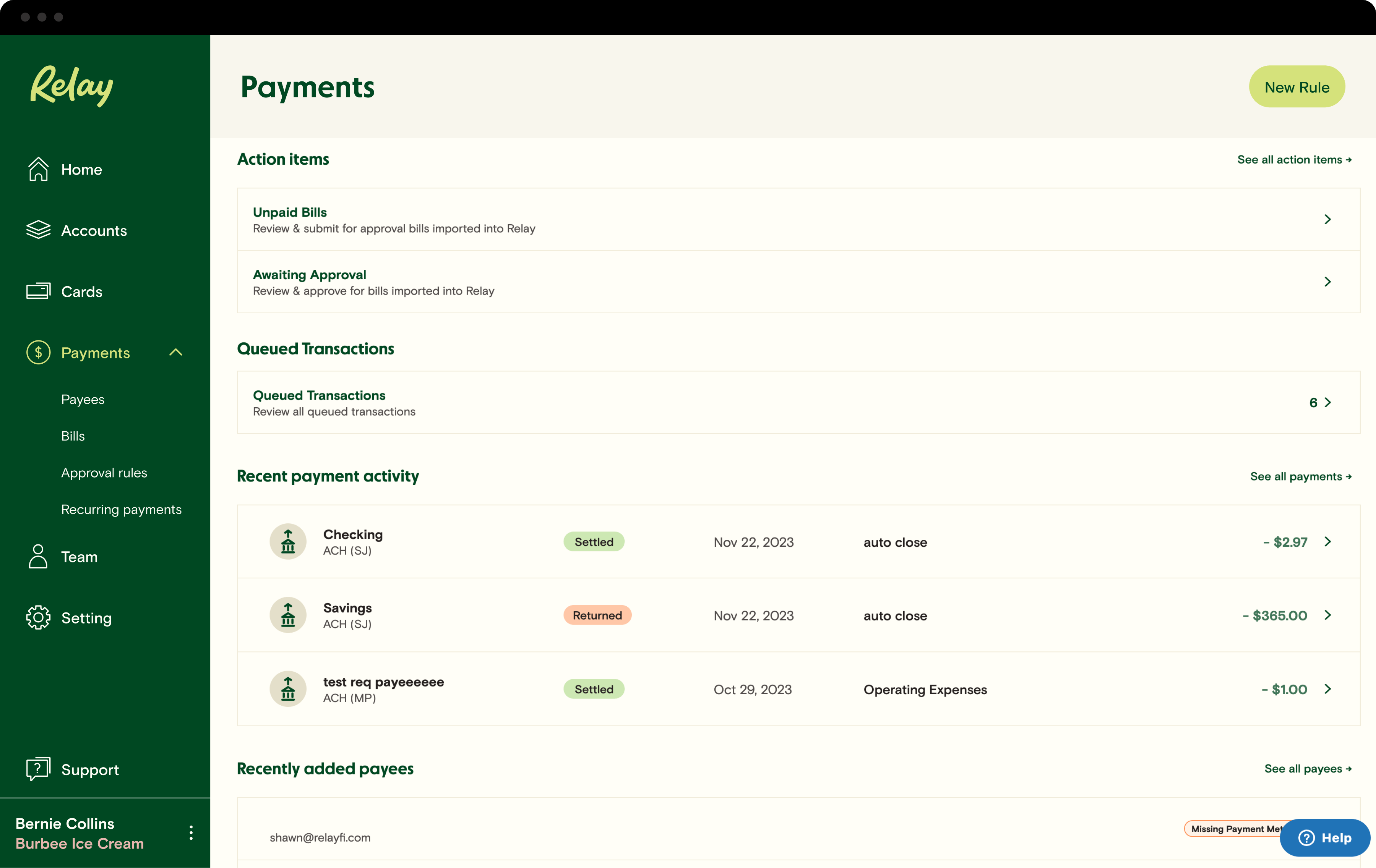
Relay