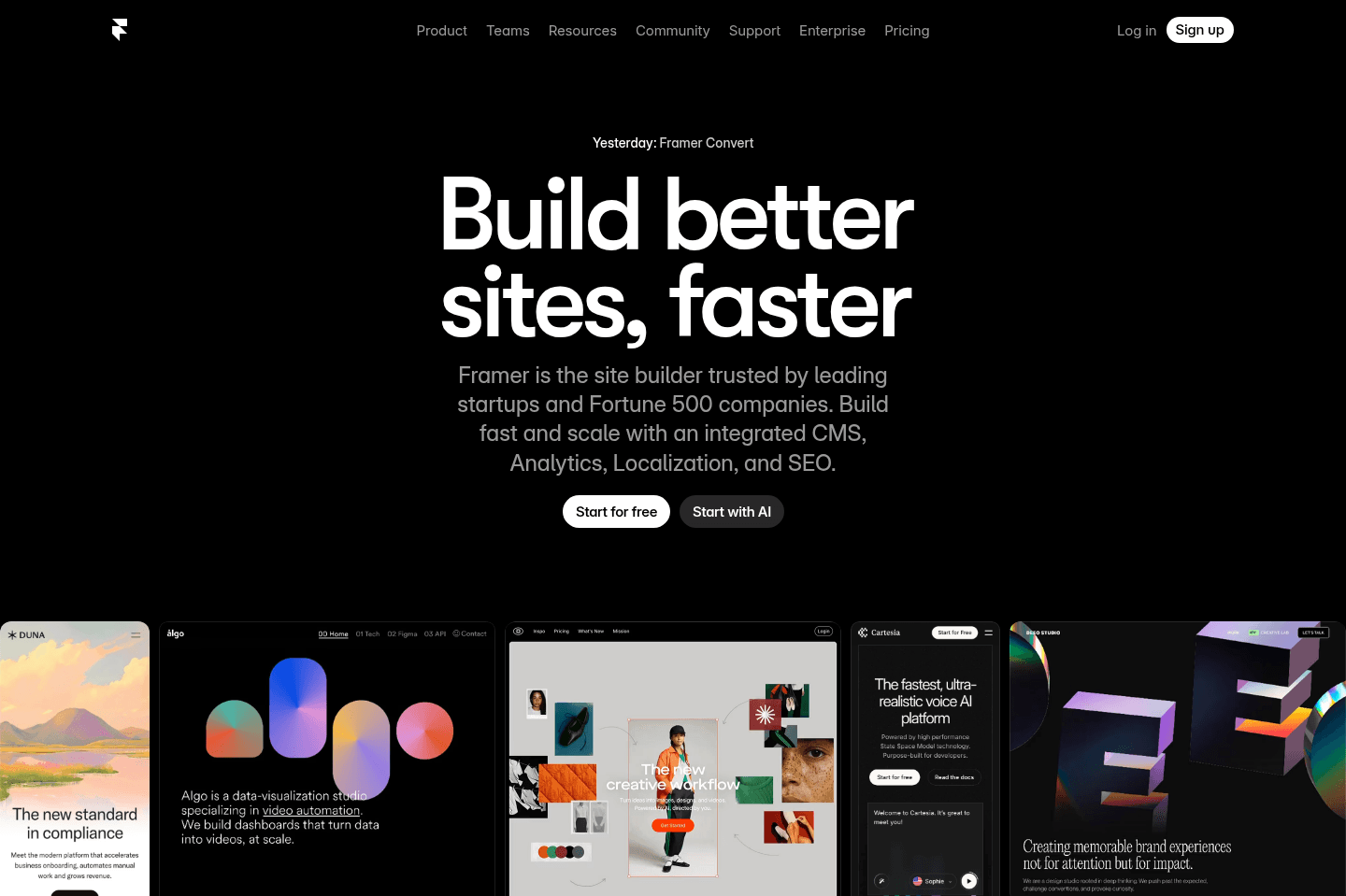
Review Summary
Review SummaryFramer lets you quickly build beautiful, simple marketing websites or personal blogs with slick animations and a visual interface that feels a lot like Figma, making it perfect for designers or anyone who wants something eye-catching without dealing with code or complex structures. If you need a site with advanced CMS relationships, want to scale to something bigger, or care about affordable Cloudflare integration, skip Framer and look elsewhere.
The Startup Growth Stack I Use as a Founder
The Startup Growth Stack I Use as a FounderWhat is Framer?
What is Framer?Framer actually started as a mock-up tool like Figma, but has since evolved more into a proper website builder.
People love the animation capabilities and lightweight-functionality of Framer over other more substantial website builders like Webflow. That said, you need to put a lot of thought into if Framer is right for the project at hand before committing to it.
The way we see it, if you're looking to build out a basic (and beautiful) marketing website (without hopes for it to evolve into something more complex), or a personal blog, Framer would likely be the best solution.
If you're looking to scale something substantially larger, planning on investing in a robust blog, or potentially even an eCommerce component and/or membership login in time, Webflow would be the better pick.
That said, Framer is almost as easy to use as Figma. So if you're more a designer and looking to get a website mocked up and built in the same tool, that's where Framer has done an incredible job filling a void in the market.
For example, in framer, you don't need to worry as much about grids, flexbox, and other traditional CSS terminology, whereas with Webflow, it definitely becomes easier to work with if you have some foundational understanding of at least basic CSS.
One of the other great things about Framer is the immense Templates marketplace that talented web designers have been building out. When you have a website builder that's as easy to use as Figma, you're going to get beautiful templates built by amazing designers.
Framer also has basic website analytics included, although you might prefer a more cohesive solution like Fathom Analytics if you want to have a bit more control over things like conversion tracking and uptime monitoring.
Who is Framer for?
Who is Framer for?Framer is best for designers and small teams who want to launch a beautiful marketing site quickly without needing to understand web development.
You may have seen the Zapier logo or other impressive logos on the Framer website. Or better yet, might have even heard influencers saying that Zapier switched to Framer.
This is simply not true, and it seems to be more these people pushing for validation in their love for Framer instead of actually looking into what these logos actually mean.
Zapier used Framer to display their new brand guidelines over at brand.zapier.com—while this is amazing, it's really just a relatively basic website with primarily embedded videos, animations, and importantly, little to no complexity. This is exactly the thing that Framer is great for.
For Zapier's primary marketing website, that's where you'd need a tool more like Webflow to actually build out the level of complexity and sophistication that is required (take a look through our website here—we have some similar levels to the complexity of the Zapier site).
Both of which have no shortage of relational databases happening between apps, integrations, and blog posts.
That said, Framer does have some great customers using it for their main marketing website.
Here's a few examples:
- Superhuman Mail (Email)—Great dark theme example
- Framer (Website Builder)—Yep, Framer uses Framer
- Loops (Email Marketing)—Just rebuilt their marketing site in Framer
- Efficient VC (Venture Capital)—Wanted to see first-hand how it'd be 🔥
Just keep an eye out when checking out Framer sites, you'll see they are quite basic marketing websites, which is totally fine! Just trying to get across the differentiation between Webflow and Framer.
Key Features
Key FeaturesSimplicity
SimplicityMaybe you're here because you've even seen one of the beautiful templates on Social Media and you're considering switching to it for your company site from Squarespace or even Webflow.
Well, to help you understand if Framer is right for you, if we had used it for this site when we first started building it, things would have been great initially. We first thought this site was just going to be a marketing site for our integration services.
That said, as we've evolved our business, Webflow has been there light alongside us, allowing us to naturally scale into a more complex web app. There's no way we'd have never been able to build the site into what it is today (and what it's evolving into) had we used something like Framer.
Since it doesn't use a re-usable class-based approach (like normal web development), it definitely at times makes for frustrating redundant components. While they do have component functionality for re-usable areas, it's more similar to that of Figma, still making it a bit of a pain to build.
That said, if/when we rebuild the site for Efficient VC or my personal website, you best be sure we'll be using Framer to do so!
CMS
CMSWhile Framer has CMS functionality to write things like blog posts and other database functionality, they are missing some more granular features when it comes to the CMS.
For one, there's no "quote" functionality oddly enough, which is actually quite helpful to have in blog posts to further break things out (like this):
Quotes are something that you definitely miss when moving from Webflow to Framer.
The CMS is a database, but not a relational database. So say for example, you have one CMS collection called "Apps", and another called "Integrations", you can't reference the "Apps" CMS collection from the "Integrations" CMS, which results in much less powerful sites.
This is the exact area as to why the site you're on right now could never exist on Framer. There's at-least 5 relational CMS connections on each of our core pages.
Cloudflare Proxy Access
Cloudflare Proxy AccessAre you someone that wants to use Cloudflare for things like bot detection and general caching of your site? Yeah, us too—it's a super reasonable request and technically even completely free (well, at least on the Cloudflare side of things).
Framer decides to categorize this as an "enterprise feature" so to enable the Cloudflare proxy to stop bots and spam along with general Cloudflare functionality, you need to purchase a $350/mo add-on called Custom Proxy Setup. So yes, even if you're paying $5/mo and using Framer as a side project that you just want to prevent tons of bot spam results showing up in your Fathom Analytics implementation, that'll now cost you $355/mo.
Yes, it's absurd, and their team tries justifying why they do this here—just stop gatekeeping using Cloudflare proxy for your own fee, please.
Final Verdict
Final VerdictOkay, so we've actually rebuilt the Efficient VC site and chose to use Framer, so if you're interested in seeing how a Framer site feels, check out Efficient VC.
If you have a less complex site that you want to load super quickly, have beautiful animations, and a visual interface for editing, and you're comfortable with a design tool like Figma, use Framer.
If you have more complex needs in the site you're building, like the site you're on right now, which has interconnected CMS collections, you'll need to use a more powerful tool like Webflow.
Categories
CategoriesFramer fits into multiple categories based on what it actually helps you do. Each category highlights a different strength and the efficiency points it earned, helping you compare tools not just by features, but by how well they actually perform.
Keep exploring the best software across categories, or explore Framer alternatives