
Summary
Summary Help ScoutBest
Best help desk for customer centric teams
Best help desk for customer centric teams GorgiasRecommended
For eCommerce Shopify stores
For eCommerce Shopify stores PlainRecommended
Best for product-led software companies
Best for product-led software companies FrontRecommended
For teams managing support across email, chat, and social
For teams managing support across email, chat, and social IntercomRecommended
For real-time live chat support
For real-time live chat support
Help Scout
Help ScoutBest alternative for human-centric support teams.
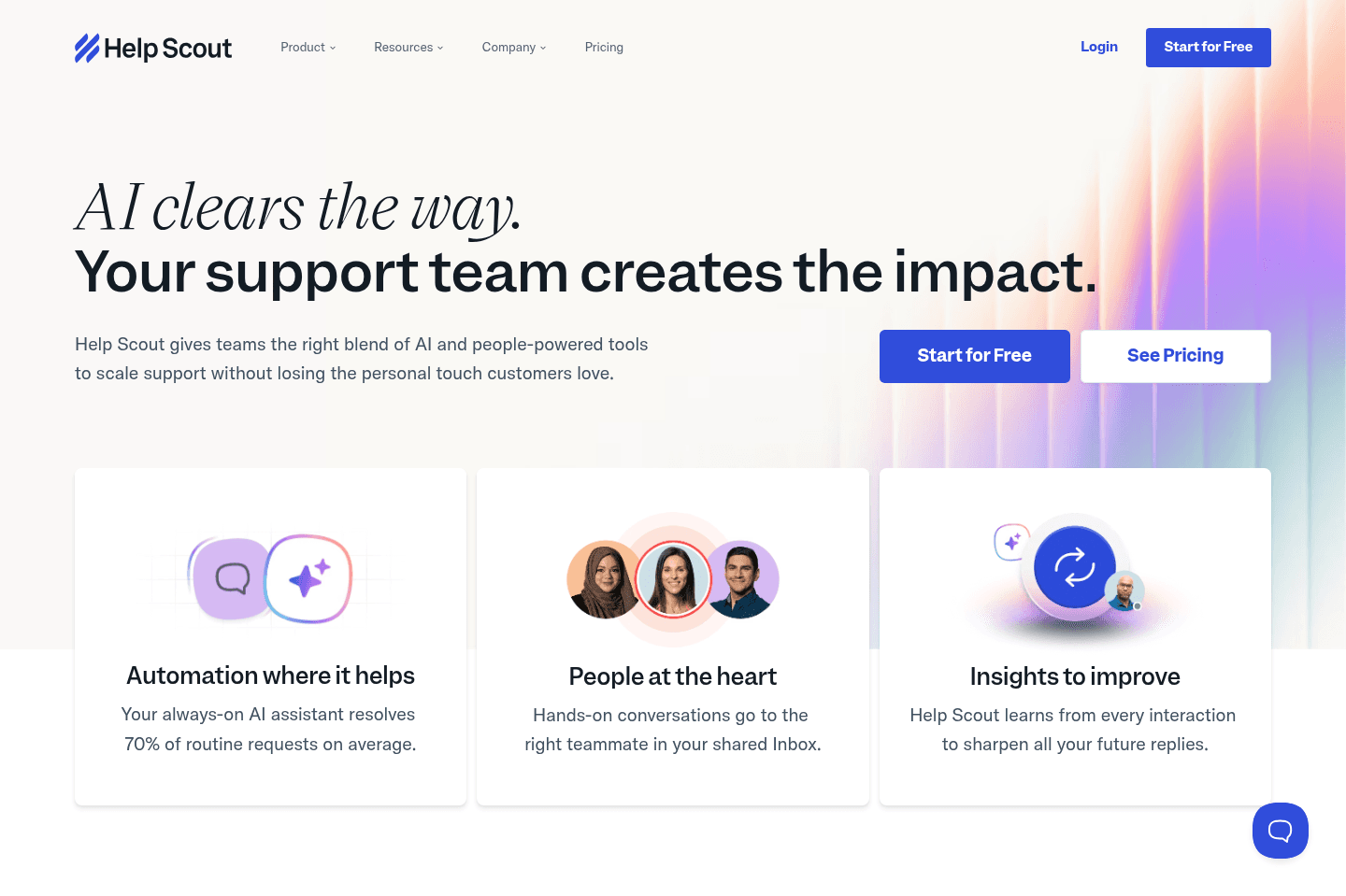
Help Scout is a great alternative for those who want their help desk to reflect a genuine commitment to customer care, not just ticket resolution. If your team values direct, personal responses and wants customers to feel like they're talking to real people, this tool stands out. The way it handles live chat and email sets clear expectations, so visitors never feel misled by bots or unreachable agents.
It's especially well suited for small to mid-sized teams that need flexible workflow automation and strong collaboration without sacrificing a human touch. The platform makes it easy to organize everything from support to sales, and gives you robust tools for working together, like seeing what teammates are typing and jumping in to help when needed.
If you rely on managing help desk tasks from your phone, be aware that some automation features are missing from the mobile app, which can be limiting for workflow-heavy users on the go.
Gorgias
GorgiasBest alternative for Shopify integrated support.
Gorgias is a great alternative for those who run eCommerce stores and need a help desk that ties directly into Shopify. If you want your team to see customer order history right alongside support tickets, this setup makes it easy to handle questions without switching tools.
It also works well for stores that get a high volume of support requests. The built-in automation can handle common questions, so your team spends less time on repetitive replies and more time solving unique issues.
If your business is not focused on eCommerce or you do not use Shopify, Gorgias will not be the best fit.
Plain
PlainBest alternative for product-focused support teams.
Plain is an alternative for those who want their support team tightly connected to product and engineering, especially if you're already using tools like Slack, Linear, or Stripe. If your workflow relies on deep integrations and you need to turn Slack messages into tickets or link support directly with product issues, Plain fits well into that environment.
This tool stands out for teams that see support and development as a shared effort, rather than separating support into a traditional shared inbox model. It's built with an API-first mindset, so developer-heavy teams will find it flexible for custom workflows.
If your team needs a help desk for non-technical staff or you expect mature automation, knowledge base, or classic shared inbox features for things like billing or admin emails, Plain will feel limited. It's best for product-led SaaS or developer teams who want support to feed directly into product work.
Front
FrontBest alternative for teams juggling multiple support channels.
Front is an alternative for those who are handling customer support across several places like social channels, chat apps, and different inboxes. If your team is already dealing with messages from Facebook Messenger, Twitter DMs, and email, Front helps you gather everything in one place so nothing slips through the cracks.
If you plan to keep your support centralized through a single email, or if your team is small and prefers direct tools for personal email, you probably won't get much out of Front's collaboration features.
Front works best when you fully commit to using it as your main inbox and need to pull in conversations from all over. If you don't actually need to manage that kind of channel sprawl, it may be more than you need.
Intercom
IntercomBest alternative for live chat centered support.
Intercom is an alternative for those who want to make live chat the main way they handle customer conversations. If your team is set up to respond quickly and can dedicate people to being available for chat, Intercom fits that workflow well.
If you run a larger operation and can justify having a few full-time staff focused on chat, it works as a strong solution.
For smaller teams or anyone worried about keeping up with live chat demands, the pressure to respond and the pricing model can become a real problem. Costs scale quickly based on contacts and features, so it's not ideal if you're watching your budget or don't have dedicated support staff.
Video
VideoBest Shared Email Inbox? Superhuman vs Missive vs Help Scout vs Front vs Intercom vs Zendesk
Best Shared Email Inbox? Superhuman vs Missive vs Help Scout vs Front vs Intercom vs Zendesk 20:48
20:48Best Shared Email Inbox? Superhuman vs Missive vs Help Scout vs Front vs Intercom vs Zendesk
Best Shared Email Inbox? Superhuman vs Missive vs Help Scout vs Front vs Intercom vs Zendesk